Below is a full synopsis of the plot of Tom Stoppard's Leopoldstadt. We recommend you don't read this until after seeing the play, as it will spoil what happens for you.
Scene One
It is December 1899. The lights rise on a prosperous home in Vienna, the capital of Austria-Hungary, one of Europe’s great empires. The home belongs to the Merz family: matriarch EMILIA, her son HERMANN and his wife GRETA, and their eight-year-old son JACOB. The family is hosting several visitors: Hermann’s sister EVA with her husband LUDWIG, eight-year-old son PAULI, and newborn baby NELLIE; Ludwig’s sister WILMA with her husband Ernst and twin daughters SALLY and ROSA; and Wilma’s unmarried eighteen-year-old sister HANNA, visiting Vienna for the holidays from the family home in Galicia. Gretl and Ernst are Christians; the rest of the family is Jewish. Also present are the Merz household staff—POLDI the housekeeper/cook and HILDE the parlour maid—and baby Nellie’s nursemaid JANA.
The play begins with the adults enjoying coffee and conversation while the children decorate a Christmas tree. Emilia is serving a chocolate cake while Hanna plays the piano. Multiple conversations swirl about the room, mostly about the mixed faith of the family. Wilma having married the Christian Ernst was controversial for her parents. Hermann converted to Christianity prior to marrying Gretl, and their son Jacob has been both baptized and circumcised.
Hanna tells Gretl about having recently met a young Austrian military officer, Fritz, who she has a crush on. Fritz invited Hanna to tea tomorrow and she asks Gretl to go along with her, which Gretl agrees to. Gretl soon leaves to sit for her portrait. The rest of the family decides to go down the street to see a nativity scene, leaving Hermann, Ludwig, Emilia and Wilma behind.
Emilia works at writing names into the family photo album while Hermann and Ludwig discuss number theory and the recent publication by Theodore Herzl calling for a Jewish state. Hermann feels assimilation is possible in Vienna, as he and his family prove. Ludwig cautions that antisemitism continues and many Jews still don’t feel safe in Europe.
Scene Two
A few days later, Hanna returns to the Merz home to talk to Gretl. Hanna is upset that, despite having a lovely time at tea with Fritz, the man hasn’t written to her in a week, and she’s returning home to Galicia in a few days. Hanna has written Fritz a letter to express her feelings for him and she wants Gretl to look it over. Gretl advises Hanna to rewrite the letter, and she promises to have it delivered for her.
Scene Three
Gretl and FRITZ are in bed in his apartment. They have been having an affair since meeting at the tea with Hanna days ago. Gretl feels guilty about stealing him from Hanna and for cheating on her husband and decides to end the affair. She gets dressed to return to Hermann and mentions she’ll probably see Fritz around town. He thinks not, since Christians and Jews don’t move in the same circles. Gretls shares that she met Hermann at a prince’s hunting party. Fritz is surprised by this and concludes Hermann must be very rich or he otherwise wouldn’t have been invited. Gretl asks Fritz to get dressed and call her a cab, but they fall into bed again.
Scene Four
Hermann is alone at home late at night. He is dressed in eveningwear and looking at the portrait of Gretl that has been recently completed. Ernst arrives with his doctor’s bag, having been sent for and assuming Hermann is unwell. Hermann explains that he was at a gentleman’s gathering playing poker and won a huge hand. His disgruntled opponent then began to taunt Hermann with talk of his sexual affairs and that his favorite women were the wives of rich Jews. Hermann thinks the other man doesn’t know who he is, but the man—revealed to be Fritz—confirms that he does and that he was purposefully insulting Hermann and consequently Gretl. Hermann feels he has no choice as a gentleman but to demand an apology from Fritz—and a duel if he won’t comply. Hermann asks Ernst to go round to the party and convey his demands. Ernst is reluctant. Hermann again talks about his family’s assimilation into Austrian society. His great-grandfather “was a pedlar of cloth.” His grandfather owned “a tailor’s shop in Leopoldstadt.” His “father imported the first steam-driven loom from America.” Hermann feels it would be disgraceful to them to tolerate this insult. He appeals to Ernst as a fellow Christian, but Ernst leaves without responding.
Scene Five
At dawn the following morning, Fritz has just arrived home from his night on the town when Hermann, elegantly dressed, rings his doorbell. Fritz lets Hermann in and Hermann demands an apology in writing for the insult to his wife. Fritz says he has nothing to apologize for and Hermann demands a duel. Fritz, however, says his army regiment forbids him to fight a Jew. Hermann retorts that he is a Christian, but Fritz replies that in the opinion of the army, anyone whose mother was a Jew is a Jew. Fritz also shares that as a student he was a member of the German-Austrian students’ association, whose manifesto stated that since Jews have no honor, it is impossible to insult them. For these two reasons, Fritz cannot duel Hermann. Hermann is furious and incredulous. Fritz offers to write a letter to Hermann that he regrets if his behavior “fell short of good manners” and he won’t repeat it in his presence. Hermann sits in defeat. Fritz inquires how he knows Willi and if he too has horses. Hermann mentions Willi offered to put him up for membership in the Jockey Club, which makes Fritz disbelieves as it would cost Willi his membership. Hermann notices a book on the table. It’s the copy of Arthur Schnitzler’s play that he had given to Ludwig and which Gretl and Eva were looking at in the first scene. Hermann asks how Fritz knows his brother-in-law Ludwig. Fritz reveals that he knows Hanna and that she and Gretl came to tea and Gretl had brought the book. Hermann realizes that Fritz knew his wife when insulting Hermann and begins to suspect their affair. He leaves without the letter and asks Fritz not to tell Gretl he was here.
Scene Six
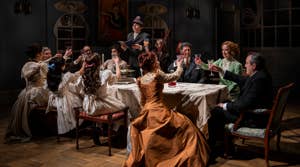
A few months later, the Merz family is hosting seder at their home, which marks the beginning of the Jewish holiday of Passover. Grandma Emilia is reciting the Kiddush as the scene begins. Wilma is stifling tears because her/Ludwig/Hanna’s mother has recently passed away. Gretl’s portrait is now hung on the wall. Emilia leads the children through the ritual dinner, retelling the story of the Jews’ exodus from Egypt. The sound of artillery and machine guns is heard and then a military band playing the Radetzky March by Johann Strauss Sr. Hermann invites Gretl to dance with him to the music.
Scene Seven
It is now 1924 and the Merz home looks mostly the same. HERMINE, the 22-year-old daughter of Hanna, is dancing to music playing on the gramophone. Sally, now 31-years-old, is holding her newborn son NATHAN and arguing with her husband ZAC. Jacob, now thirty-two, is disfigured as a result of his service in World War I. NELLIE, now twenty-five, is cutting apart an Austrian flag.
Poldi, now in her sixties, had set out wine and food in the room, but is now gathering it back up to take into Grandma Emilia’s bedroom offstage, where she is bedridden. Poldi shares that Sally is having second thoughts about going through with the bris for baby Nathan. Rosa, Sally’s twin sister, enters looking for a cigarette and says the bris is back on.
Ludwig hasn’t arrived yet because he’s talking to Dr. Sigmund Freud, who still hasn’t been made a full professor because he’s Jewish. And Hanna isn’t present because she’s practicing piano for a recital she’ll be playing at the Salzburg festival. The cousins talk about the political changes in Austria. The empire was broken apart in the wake of the war, leaving behind a much smaller Austria. Many German-speaking Austrians are now in Italy, Czechoslovakia, Poland and Yugoslavia. The right-wing Christian Social Party is in power and some, like Hanna’s husband Kurt, have become Marxists. There is still talk of a possible future Jewish state in Palestine.
Zac rushes in looking for Sally and the baby, as she seems to have changed her mind again about the circumcision. Hermine asks Rosa to take her back to America, where Rosa now lives in Greenwich Village, New York. Rosa admits she can’t; the immigration rules are too strict. Nellie laments the loss of Austrian democracy. The left are all Marxists, and the right is increasingly fascist and enamored with Mussolini. Jacob thinks both sides will still blame the Jews for the country’s problems. He and his cousin Pauli (Nellie’s brother) joined the Austrian army thinking fighting World War I would make them fully assimilated Austrians. Pauli was killed in the war and anti-semitism persists.
The doorbell rings and everyone thinks the man who arrives is the mohel here to perform the bris. However, he explains he is OTTO Floge from a local bank, here to see Hermann. Hermine flirts with him a bit until Hermann arrives home a few moments later.
Hermann stays to talk with Otto instead of going upstairs for the bris, lamenting the state of the Austrian post-war economy. Hermann has asked Otto to come over so they can draft paperwork transferring ownership of the Merz family business from Hermann to Jacob, as Hermann wants to pass it on to his son. Gretl shames Hermann for not coming to the bris. Otto shares that he has joined the Greater German People’s Party which advocates for Austria’s union with Germany, despite the union being forbidden by the Treaty of Paris that ended World War I.
Gretl runs in to announce the baby’s name is Nathan as the sounds of bombers starts to get louder and louder. Pamphlets with swastikas fall from the sky as a 14-year-old Nathan runs on to catch one.
Scene Eight
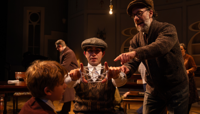
It is now November 1938. The portrait of Gretl is gone, as are many of the valubale items. The room is now cluttered with personal belongings. Sally is reading a book to her two daughters, BELLA and MIMI. Hermine is there with her son HEINI, and Nellis is there with her eight-year-old son LEO. Hanna plays the piano. Nathan and Ludwig play cat’s cradle with Leo, and Eva is serving biscuits, which have been brought by the Englishman PERCY Chamberlain.
Percy has returned from a conference in France where other countries were discussing accepting Jews who want to leave Austria, but no countries stepped up to commit to accepting more refugees. Sally says her sister Rosa is trying to get her and Zac and the children visas for America. Ernst arrives and demonstrates how to fold a jacket.
From downstairs there is the sound shouts, breaking glass and then two gunshots. The room falls silent listening until the sounds cease. The storytelling and games resume tentatively.
Percy and Nellie talk privately and he encourages her to marry him so they can escape to Britain. (Nellie’s first husband was killed by anti-leftist forces.) She is concerned about leaving the rest of the family behind. Ernst tells Ludwig that the British allowed Sigmund Freud to immigrate. He also says a school for training butlers and valets has sprung up because someone heard the British might accepts Jews as domestic servants.
Hermine reveals that Otto left her because he was forced to choose between her and keeping his job at the bank. Percy encourages them all to find ways to leave, but Eva says this will pass and that Grandma Emilia walked from Kiev to Lvov as a child when her village was burned down. She and others in the family aren’t willing to abandon everything they have to the Nazis by fleeing Austria. Percy reminds them that their fellow Austrians have welcomed Hitler and their country becoming part of the Third Reich.
A CIVILIAN enters, wearing a swastika armband. Everyone stands as he goes person to person having them identify themselves. He asks where Hermann is and they say he goes to the hospital every day to ask about Gretl but is forbidden from going inside. Zac is at work cleaning latrines for the Nazis. Hermann arrives home but the Civilian notes that one person is missing. Ernst explains Wilma is bedridden but the Civilian insists he bring her in. He demands Hanna play the piano in the meantime.
When Ernst brings Wilma in in a wheelchair, the Civilian tells the room that this apartment has been requisitioned and they family will have to leave tomorrow with only one suitcase each. He also signs orders for Wilma to be sent to a mental hospital, and he also presents Hermann with paperwork surrendering his company to the authorities.
Gretl walks in in a fur coat, frail and walking with a cane. The Civilian greets her respectfully and leaves. Leo has been holding a broken tea cup and cut himself on it. Ernst gets his doctor bag to treat the boy who needs a few stitches. Hermann goes to Gretl who is ill and mentally diminished. The family starts to pack their things and guesses they’ll be moved to the Leopoldstadt Jewish quarter.
Hermann asks Hernst to take Gretl back to the hospital since he can go inside and Hermann can’t. Ernst says he’s sorry Hermann lost the Merz family business, but Hermann reveals he transferred the business to Jacob two years ago and that Jacob is not Jewish. He is the son of Gretl and her affair with the Austrian soldier. Hermann and Gretl have sworn to it and Hermann paid off Fritz to write a sworn affidavit as well. Hermann encourages Ernst to let Wilma go.
Heini comes back to play the piano, as the sound of shouting, trucks and glass breaking is heard from outside. Ernst gets his doctor’s bag and begins to fill a syringe and kisses Wilma’s forehead.
Scene Nine
It is now 1955. 30-year-old Nathan is making a statement to an unseen person. He is telling them who he is and how he grew up visiting the Merz apartment and there was a portrait of Gretl that hung there. It was taken by the Nazis after the Anschluss. Nathan was sent to Thereisenstadt in 1942 and then to Auschwitz. His father, mother and sisters died. After the war, he saw the painting on display at the Belvedere gallery in Vienna. He insists it was the portrait of Gretl that belonged to the Merzs.
The lights shift and Nathan is now in the empty Merz apartment with 62-year-old Rosa and 24-year-old Leo. Leo now speaks with a slight English accent and uses the name Leonard Chamberlain. The Allied occupation of Austria has just concluded and the country is an independent republic again.
Nathan teases Leo for going by Leonard instead of Leopold. Leo reminds him that his mother Nellie was killed by the Germans too in the Blitz. Nathan retorts that the Germans didn’t kill his father though. Leo says Percy is still alive and remarried. Nathan reminds him that his real father, Aaron, was killed by the Austrians in 1934.
Leo explains that his mother didn’t want him to go to school with a German name, so he became Leonard Chamberlain at age 8. Nathan asks him if he remembers this room he lived in for a few weeks before he left for England, and Leo doesn’t. Rosa reveals that she has fought to reclaim ownership of this apartment successfully and will continue to fight for the return of Gretl’s portrait, however long it takes.
Leo doesn’t know much about the family history and reveals he only learned of Nathan yesterday. Nathan and Rosa are incredulous he didn’t want to learn more about his family and his Jewish lineage, but Leo admits he enjoyed being English. Rosa storms out. Nathan finds it amusing because Leo is technically the most Jewish of all three of them, having four Jewish grandparents unlike him and Rosa.
Leo asks why Nathan returned to Vienna. Nathan avows that the Jews made Vienna what it was and he wasn’t going to flee his city. Even though Austria now acts like it was a victim of the Nazis instead of willingly participating in the Anschluss. Leo now writes humorous books and speeches, which is why he was in Vienna and Rosa happened to read about his visit in the newspaper.
Nathan notices the scar on Leo’s hand and reminds him about the broken tea cup and Ernst stitching him up. Leo finally remembers and begins to cry, remembering the cat’s cradle he played with Nathan and Ludwig.
Rosa returns with a large sheet of paper that she has written the family tree out on. She gives it to Leo who apologizes. Rosa apologizes to Nathan, explaining that her lawyers recommended she only apply for visas for Sally, Zac and the kids—but she insisted on sponsoring the whole family, which held up her application. The visas came through the day Germany invaded Poland and it was no longer possible for Jews to emigrate. America never filled its quota of Jewish refugees. Nathan begins to laugh and then sob.
Rosa tells Leo about her very first memory, which is the seder we saw in Scene 6. That scene begins to play again, showing Little Rosa crying that she has forgotten where she hid the affikomen. The whole family is searching for the piece of matzo except Hermann, Ludwig and Ernst who are enjoying a glass of wine. Gretl finds the missing matzo, but Hermann whispers to her that he knows she planted that piece. Hanna then finds the missing matzo in the piano, which she removes and begins to play.
Leo continues to look at the family tree with Rosa. He inquires about what happened to each person and Rosa tells him.
- Emilia died in her own bed.
- Hermann died by suicide during Passover in 1939.
- Gretl died of a brain tumor in December 1938.
- Jacob died by suicide in 1946.
- Eva died on a transport in 1943.
- Ludwig died in Steinhof in 1941.
- Pauli died in Verdun fighting World War I in 1916.
- Nellie died in England during the Blitz.
- Aaron died in artillery fire in Vienna.
- Wilma died, with Rosa not elaborating.
- Ernst died in Auschwitz.
- Hanna died in Auschwitz.
- Kurt died in Dachau in 1938.
- Zac died on a death march.
- Sally died in Auschwitz.
- Mimi died in Auschwitz.
- Bella died in Auschwitz.
- Hermine died in Auschwitz.
- Heini died in Auschwitz.
Leo folds up the piece of paper as Hanna continues to play the piano. The lights fade out and the play ends.
.png?w=200&h=114)