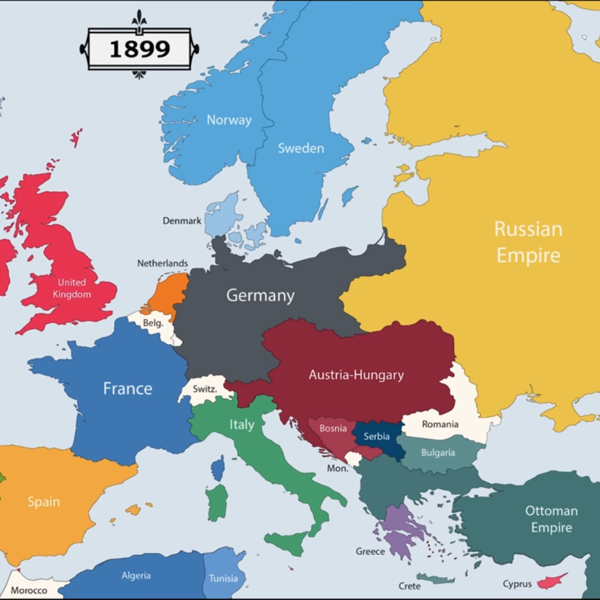
1804 – The Austrian Empire is created through unification of various states related to the House of Habsburg-Lorraine. Francis II, the current Holy Roman Emperor, becomes Emperor of Austria and holds both titles.
1806 – The Holy Roman Empire dissolves during the Napoleonic wars as several German states come under Napoleon’s sphere of influence. Francis II remains Emperor of Austria.
1815 – The Congress of Vienna establishes European borders in the wake of the Napoleonic wars. Austria gains territory in northern Italy. A new German Confederation of 39 independent German-speaking states replaces the more centralized Holy Roman Empire.
1848-49 – Revolutions break out across Europe. Hungarians enact democratic reforms, which new Austrian Emperor Franz Joseph I disregards. An open revolt for Hungarian independence is quashed by the Austrian military. In Germany, protesters call for a united German state to replace the Confederation.
1859 – Austria loses its holdings in northern Italy during the Second Italian War of Independence.
1866 – Austria and Prussia go to war, leading to the dissolution of the German Confederation. Prussia triumphs and Austria’s influence in the German states is diminished.
1867 – Needing to shore up the empire after two military defeats, Austria reaches a compromise with Hungarian political leaders on a new alignment of their countries as a union of equal sovereign states. Franz Joseph I becomes a dual monarch, Emperor of Austria and King of Hungary, and the empire becomes known as Austria-Hungary.
1878 – The Congress of Berlin approves Austro-Hungarian occupation of Bosnia and Herzegovina, which had previously been part of the Ottoman Empire until its defeat in the Russo-Turkish War.
1879-1883 – Various alliances are made to prevent war from breaking out in the Balkans. Austria-Hungary becomes more aligned with the German Empire.
1889 – Adolf Hitler is born in an Austrian town near the border with Germany.
1896 – Theodore Herzl, an Austrian Jewish journalist, publishes Der Judenstaat advocating for a Jewish state.
1897 – Gustav Mahler, an Austrian Jewish composer, converts to Catholicism in order to conduct the Vienna opera. Karl Lueger is elected mayor of Vienna on a platform full of antisemitic rhetoric.
1900 – Sigmund Freud publishes The Interpretation of Dreams.
Leopoldstadt scenes 1-6 take place between Christmas 1899 and Passover 1900
1907 – Hitler moves to Vienna to study fine art but his application to the Academy of Fine Arts is rejected twice.
1908 – Austria-Hungary annexes Bosnia and Herzegovina, which it had occupied for thirty years. The move angers Serbia, Italy and Russia.
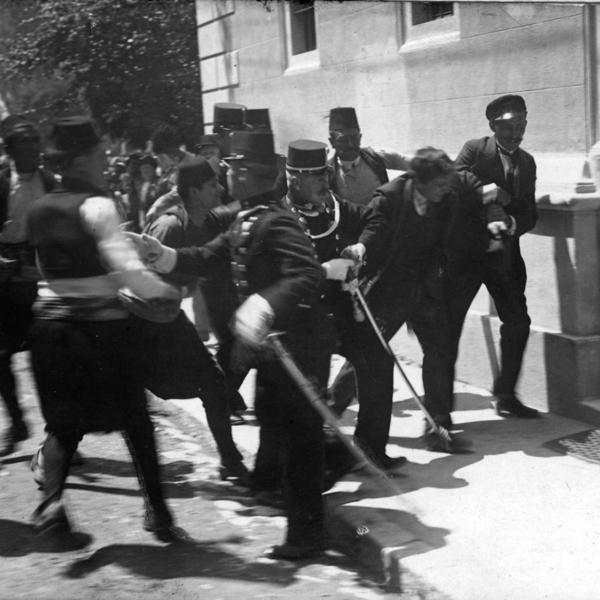
1914 – Franz Ferdinand, heir to the Austro-Hungarian throne, is assassinated in Sarajevo in June by a Bosnian Serb nationalist. Austria-Hungary declares war on Serbia. Russia comes to the aid of its Slavic ally Serbia, and other existing alliances draw most of Europe into World War I by August. Germany, Austria-Hungary and the Ottoman Empire make up the Central Powers, while Russia, France and Britain lead the Allies.
1915 – A formerly neutral Italy joins the Allies instead of honoring its alliance with Austria-Hungary, hoping to claim territory from its former ally. Austria-Hungary holds off Russian and Italian advances on the Eastern and Southern fronts but suffers significant casualties during its invasion of Serbia. Germany increasingly takes leadership of military strategy for both empires.
1916 – Emperor Franz Joseph I dies and is succeeded by his grand-nephew Charles I & IV. Charles tries to secretly negotiate peace with the allies but is unsuccessful.
1917 – The British government declares it support for the idea of a Jewish state in Palestine. The letter expressing this support, written by British foreign secretary Arthur Balfour, becomes known as the Balfour Declaration. Russia exits World War I as the Soviets come to power.
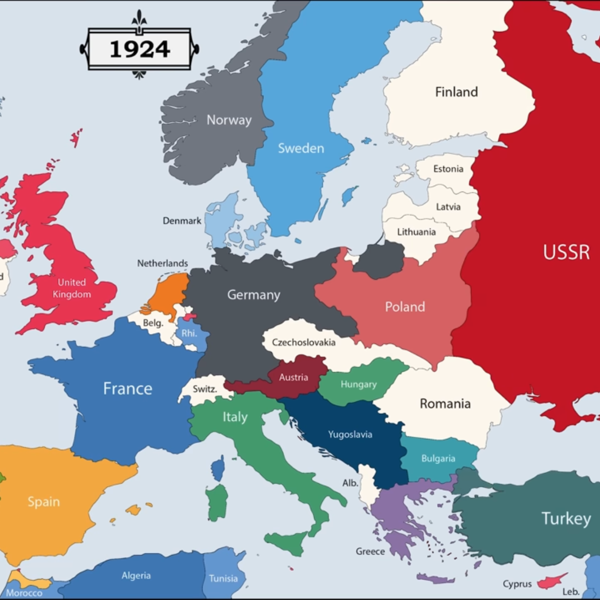
1918 – Austria-Hungary splinters under a food crisis and growing nationalist and socialist movements as defeat in the war seems imminent. In October, Charles proposes turning the empire into a federal state of five kingdoms, with devolved autonomy for Austria, Hungary, Croatia, Bohemia and Polish-Galicia. The Allies, however, support the independence movements in those countries. Hungary votes to terminate the union, and Czechoslovakia and Yugoslavia soon declare their independence. Charles abdicates and the transitional Republic of German-Austria replaces the monarchy.
1919 – The Treaty of Saint-Germain-en-Laye establishes the new borders of Austria, which are 60% smaller than the old borders of the Empire. The new country mostly consists of Alpine and Danubian territory, and many German-speaking people now reside outside its borders. Vienna is now an extravagant capital city of 2 million people within a country of only 8 million. The treaty also outlaws Habsburg rule and forbids the new Austria from uniting with Germany. The League of Nations also emerges out of the Paris Peace Accords as an intergovernmental body for maintaining peace. In Munich, Hitler joins the German Workers’ Party.
1920 – A new Austrian constitution is enacted, creating the First Austrian Republic and removing any mention of uniting with Germany. The Christian Social Party, which is strongly aligned with the Catholic Church, governs the country via coalition with other right-wing parties. The Heimwehr, a right-wing paramilitary group, is also founded to fight against socialism and marxism.
1922 – With inflation rampant, Austrian Chancellor Ignaz Seipel secures an economic bailout from the League of Nations, which begins supervising the republic’s economic policy.
1923 – The opposition Social Democratic Workers’ Party establishes its own paramilitary organization, the Republikanischer Schutzbund, to fight for leftist causes. Hitler and allies attempt a coup in Bavaria which fails. While imprisoned, he begins writing Mein Kampf.
Leopoldstadt scene 7 takes place in 1924
1927 – A large protest breaks out in Vienna in July, after right-wing paramilitaries were acquitted of murdering left-wing activists earlier in the year. Protesters set fire to the Palace of Justice. Police fire on the crowds and kill 89 protesters.
1932 – Engelbert Dollfuss becomes Chancellor of Austria at the head of a right-wing coalition government.
1933 – Dollfuss creates a new political party, the Fatherland Front, merging the Christian Social Party and the Heimwehr into one platform advocating for a Catholic Austria separate from Germany. Months later, the communist party, the Nazi party, and the paramilitary Schutzbund are banned.
1934 – A Schutzbund meeting in Linz is raided by police, which sparks clashes across Austria between left-wing groups and federal forces. The Karl Marx Hof housing project in Vienna is shelled by the army, killing civilians. The Social Democratic Party is banned and a new authoritarian constitution is enacted with the Fatherland Front the only legal political party in the new Federal State of Austria. In July, Dollfuss is assassinated by Austrian Nazis attempting a coup. Italian leader Mussolini warns Hitler against intervening and the coup fails.
1936 – New Austrian Chancellor Kurt Schuschnigg attempts to appease Nazi Germany by releasing imprisoned coup perpetrators.
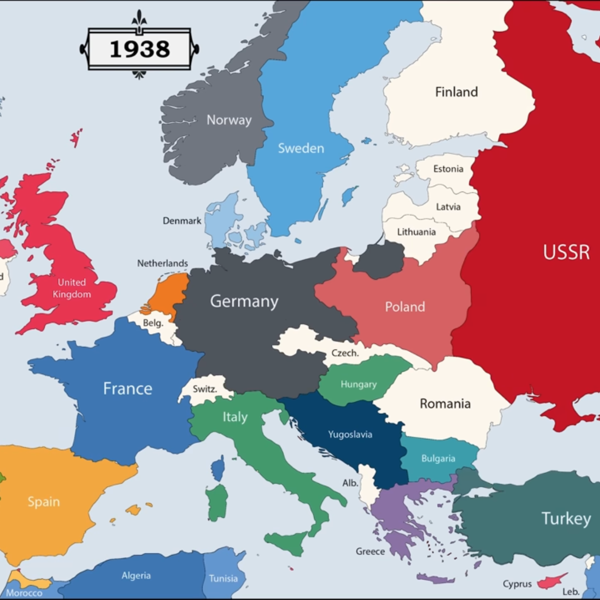
Early 1938 – At a summit in February, Hitler demands Schuschnigg hand over power to Austrian Nazis. The Austrian Chancellor agrees but then announces a national referendum on March 13th for Austrians to vote on whether they want to remain an independent country. Hitler furiously demands Schnuschnigg’s resignation two days before the planned vote, and Nazi troops invade the next morning, met by many cheering Austrians. The Anschluss is ratified on March 13th and Austria becomes a province of Nazi Germany.
July 1938 - Evian Conference
November 9, 1938 – A night of rioting is carried out across Nazi Germany targeting Jewish businesses and synagogues. Almost all of Vienna’s synagogues are destroyed. The pogrom becomes known as Kristallnacht.
Leopoldstadt scene 8 takes place on November 9, 1938
March 1939 – Hitler violates the Munich Agreement by occupying all of Bavaria.
September 1939 – Germany invades Poland and World War II breaks out. By this point, 125,000 Jews have fled Austria and only around 60,000 remain, mostly in Vienna.
February 1941 – Austrian Jews begin to be deported to death camps.
November 1942 – The Viennese Jewish community is officially liquidated, although a few thousand remain in hiding.
Fall 1943 – Allied negotiations on the future of Europe result in the Moscow Declaration, which states “Austria, the first free country to fall a victim to Hitlerite aggression, shall be liberated from German domination.”
1944 – After the Allied invasion of Italy, Austria is within reach of allied bombers and Vienna begins to be targeted.
March 1945 – Soviet troops enter Austria and capture Vienna.
April 1945 – Austrian statesman Karl Renner forms a government with the support of the Soviets and attempts to declare Austria as a country independent from Germany. American and British troops decline to recognize Renner’s government and occupy western and southern Austria.
May 1945 – Germany surrenders to the Allied powers.
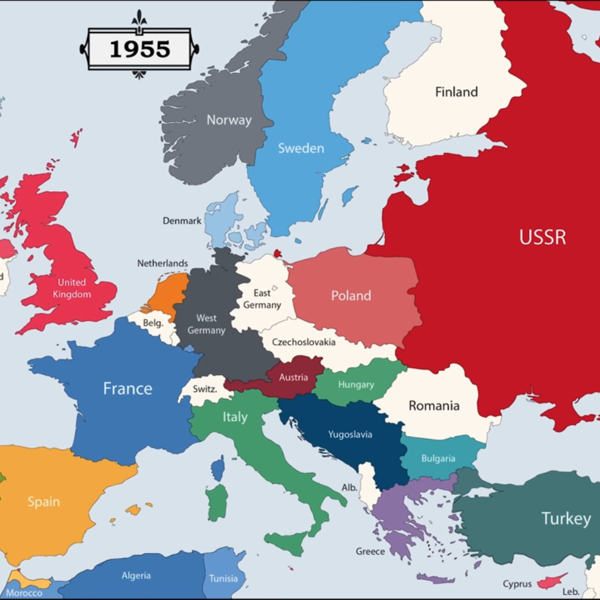
July 1945 – The Allies agree to divide Austria into four zones, governed by the Americans, British, French, and Soviets. Vienna is also divided into quadrants with an international zone in its center. Jews returning to Austria are not offered restitution of property.
1950 – Around 13,000 Jews have returned to Austria, mostly living in Vienna.
May 1955 – The Austrian State Treaty reestablishes an independent Austria free from allied occupation.
October 1955 – The new parliament of the Second Austrian Republic passes a Declaration of Neutrality.
Leopoldstadt scene 9 takes place in 1955
1986 – Kurt Waldheim is elected president of Austria. During the campaign, Waldheim’s conscription service during World War II as an intelligence officer in the Nazi armed forces comes to light. Many countries distance themselves from Austria throughout Waldheim’s presidency.
1991 – Waldheim makes a public apology in July on behalf of Austria and admits responsibility for its crimes during Nazi occupation.
.png?w=200&h=114)