.png?w=600&h=600)
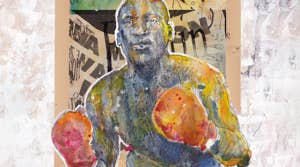
The events of The Royale are inspired by Jack Johnson’s pursuit of the heavyweight champion of the world title.
He technically had to fight for this title twice. Once against Tommy Burns, and again against Jim Jeffries to officially legitimize it. In both cases Johnson’s biggest hurdle was not a lack of skill or resources, it was simply getting the white man to say “yes”. Below is a timeline of key events that led to Jack Johnson winning the title of undisputed heavyweight champion of the world on July 4, 1910.
March 31, 1878 – Jack Johnson was born Arthur John Johnson in Galveston, Texas.
- Born to Henry and Tina “Tiny” Johnson, he was their first son, and third child of nine. His mother was a washer woman, and his father was a civil war veteran working as a janitor and occasional preacher. They lived in a small house at 808 Broadway. As a pair of formerly enslaved folks, owning property and finding a way to provide for their children was no minor feat. Johnson credits his mother for instilling in him a belief that he could do anything in the world if he set his mind to it.
Summer 1895 – Jack Johnson learns to box.
- Johnson first learned to box from his boss, Walter Lewis, at one of his first jobs painting carriages. He would spar with others after work for fun. One of his earliest paid fights was against a dockworker named John “Must Have It” Lee on a beach in Galveston. He won and earned a purse of $1.50 (about $60 present day).
Spring - Winter 1899 – Jack Johnson is discovered.
- After fighting his way through Galveston and some of the surrounding cities, Johnson decided to try his luck in the bigger market of Chicago. Though he didn’t have much luck in the city, as he was leaving he was discovered at a train station in Springfield and offered a spot in a Battle Royale. The Royale was just a sideshow to the main event scheduled that night, but there were a few heavy hitters from the Chicago fighting world in the audience and the impression he made on them allowed him to break into the industry.
Feb 3, 1903 – Martin vs. Johnson.
- Johnson is matched against Denver Ed Martin, the colored heavyweight champion of the world. Both were very defensive fighters, so the match lasted the full 20 rounds with no knockouts. In the end, Johnson is awarded the decision taking the title from Martin and becoming the colored heavyweight champ. However, this was not an officially recognized title and Johnson would not stop until he had his chance at the real thing. He began challenging Jim Jeffries, the current heavyweight champion of the world, shortly after.
May 2, 1905 – Jim Jeffries retires with the heavyweight title claiming there were no “logical challengers” for him to fight.
- Though Johnson (and many other prominent Black boxers of the time) were actively challenging him, Jeffries drew the color line and refused to fight any Black fighters. Instead, he settled down on an alfalfa farm just outside of LA. This was an unprecedented move from Jefferies, and the fighting world still needed a title holder, so promoters arranged for the two best white boxers after Jeffries to fight for it. Marvin Hart won the fight and the title. The legitimacy of this fight was disputed across the fighting world, but promoters needed the title to remain in play for business.
February 23, 1906 – Hart vs. Burns.
- Tommy Burns takes the heavyweight title from Marvin Hart. He openly states he will fight anyone of any color, opening the door for Johnson to finally have a go at the world title. However, Burns claimed it wouldn’t be worth it to fight Johnson unless he was guaranteed a payout of $30,000 (about $1 million present day) win, lose or draw. Most promoters saw this as a ridiculous ask and refused to fund the fight.
December 26, 1908 (Boxing Day) - Johnson vs. Burns.
- Businessman turned fight promoter Hugh “Huge Deal” McIntosh decides to take on the challenge of organizing the Johnson vs. Burns fight. He gets together a group of funders to cover the $30,000 Burns demanded. Johnson is only paid $5,000. The fight is set to take place in Sydney, Australia at McIntosh’s 20,000 seat stadium. They sell out the stadium with an additional 30,000 people standing outside of it. Johnson wins effortlessly, toying with Burns through the entire fight, much to the chagrin of everyone in the audience. After 14 rounds the fight is stopped out of fear of how the majority white crowd will react to the sight of a bloodied and beaten Burns hitting the canvas. Johnson is declared the winner to a silent stadium. For the first time in history, a Black man now holds the title of heavyweight champion of the world.
April 19, 1909 – Jeffries comes out of retirement and announces his challenge to Jack Johnson.
- Johnson’s return to North America set the country on fire. He landed in Toronto, Canada publicly claiming Hattie McClay, a white woman, as his wife. He was also, notably, without his white manager Sam Fitzpatrick. This brazen display spurred the call for a “great white hope” to knock Johnson out and return the title to its “rightful” place. After immense pressure from the sporting community (and half the country) Jeffries finally heeded the call. He promised to fight Johnson after an eight-month training tour provided Johnson didn't lose to another white competitor first.
October - November 1909 – Fight details are established.
- Johnson and Jeffries enter into negotiations for the parameters of the fight. Johnson largely represents himself, which was unheard of for a Black boxer to do at the time. The fight is set for July 4, 1910. It will be 45 rounds and the winner’s purse will be split 75-25 (later amended to 60-40). The promoters of the fight were George Rickard and Jack Gleason. They pitched a $101,000 purse (around $4 million present day; the largest in boxing history at the time), a $10,000 bonus for each fighter and a portion of the film rights for both fighters.
July 4,1910 – Johnson vs. Jeffries: The Fight of the Century.
- Tens of thousands of people poured into Reno, Nevada (which was a small mining town of 11,000 at the time) to witness the “Fight of the Century”. People around the country who couldn’t attend in person set up various measures to follow the fight: Prayer vigils for a Johnson victory were taking place in Kansas; students and faculty gathered in an auditorium at Tuskegee and paid for a special telegraph line for updates; bulletin boards were set up in Times Square to post fight updates; fight reenactors were set up in San Francisco; an announcer was set up in the Pekin Theater in Chicago for an audience of five thousand people with Jack Johnson’s mother and sisters seated on stage as guests of honor.
The stadium in Reno held 30,000 spectators with an additional 20,000 outside. Many prominent figures in the boxing world were in attendance. The fight lasted 15 rounds with both men getting some decent hits in. By round 11 it was clear Johnson would be the victor. In round 15, Jeffries’ seconds had to lift him to his feet and throw him back in the ring for the fight to continue. Johnson hit Jeffries four more times, knocking him out and winning the fight.
Jack Johnson’s victory over Jim Jeffries set off a series of celebrations and violent reactions across the country: In Chicago they gathered on Johnson’s front lawn as his mother waved a poster of him from the window crying with joy; in New Orleans a Black marching band had to flee from a white mob throwing bricks at them for celebrating; Black families in a small mining town in Illinois took to the streets chanting “Hallelujah! We are a race of champions!”; a Black construction camp in Georgia was shot up by white riflemen. In the aftermath of the fight somewhere between ten and twenty Black people were killed and hundreds more were injured.
The simultaneous expressions of joy and violence were a direct demonstration of the endemic division our country is still battling today. It is difficult to conceive that something as individual as a battle of strength between two men on a 24 square foot canvas could affect the soul of a nation, but when the foundation of a society is built on the fragile narrative that one group of people deserves less than another, a single crack can break it down.
.png?w=200&h=114)