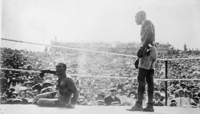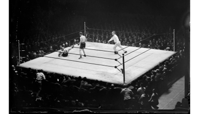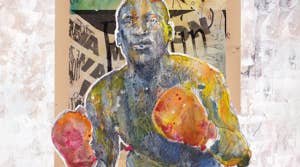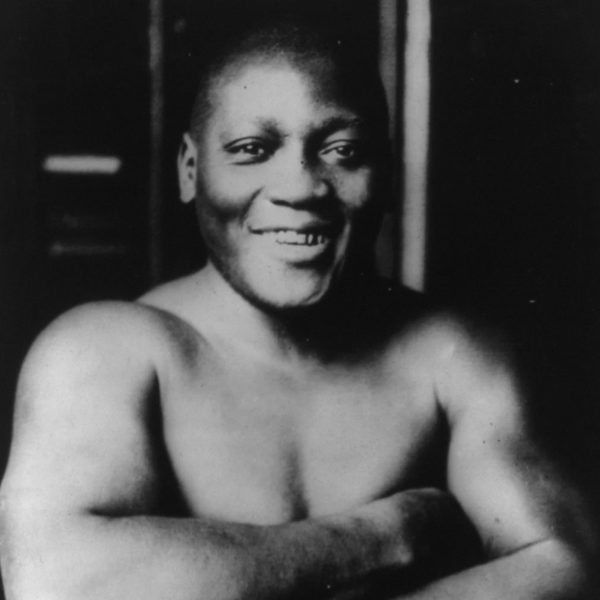
Jack Johnson is regarded as one of the best defensive heavyweight boxers ever and was the first Black person to hold the title of heavyweight champion of the world in 1908.
So, why isn’t he more well known? Why are there so many Black boxing legends whose names spring to mind before his does, even though they all owe their careers to his groundbreaking achievement? The answer lies in Jack Johnson being ahead of his time. His unconventional approach to life was one of his greatest strengths, but it created a figure too complex to fit comfortably in the mold of those who are preserved in the history of this country.
Jack Johnson grew up in Galveston, Texas. His neighborhood was relatively integrated despite being a southern city in the time of Jim Crow. The culture of the city benefited from being a seaport, which meant there was a constant flow of different types of people coming through. This cycling of people and ideas through the town made it harder to maintain the strict de facto segregation that relies on everyone being clear on the rules. The schools and many businesses were segregated, but Johnson recalled having a lot of white friends whom he felt great affection for. As a child he had an uncommon confidence that was fueled by his mother’s constant teachings that he could do whatever he set his mind to. She’s quoted in the Galveston Daily News saying:
And I says, “Shucks, boy, what you talking about? What you think you're going to be–president?” He said, no, he wasn't figuring on being president, but he expects he'll be something what'll be just about as big. And that child sure was talking a parable that night.1
This way of thinking may feel commonplace in a modern context, but we have to remember that Johnson was only one generation removed from slavery. The Black population of the country was actively fighting to legitimize their personhood in the eyes of the nation, and here was a young child imagining himself as important as the president.
The self-confidence that was instilled in Johnson as a child continued to flourish and grow as he did. He was infamous for his flashy style inside and outside the ring. He was known for taunting his opponents in the ring, involving the crowd and ringside reporters in his antics. He was often referred to as “The Man with the Golden Smile” because he was always showing off his gold-plated top row of teeth, and “The Sport” because he dressed in the flashy, opulent style of those in the “sporting” culture of the time. Johnson and the women who traveled with him were frequently decked out in furs, fine tailored suits and diamonds on each finger. He loved to party, gamble, drive fast cars and frequent saloons. He even owned one in Chicago, the Café De Champion. At the height of his success many noted that he traveled like a king. Unfortunately, Johnson was living in a time when Black men were not allowed to be kings, they were barely allowed to be men.
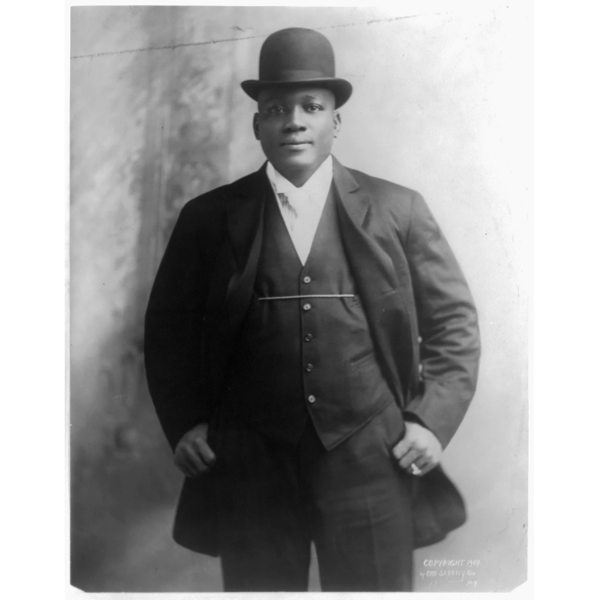
The brazen opulence of Johnson’s life did not sit well with the white part of the country because he was thought to be living beyond his station. It did not sit well with the Black part of the country because he was thought to be making a mockery of the prevailing sentiment of Black respectability at the time. Both factions sought to control him, but Johnson was not a man who was easily controlled. He was strong-bodied and strong-willed, and these great strengths eventually led to his downfall.
The author and activist James Weldon Johnson, a contemporary of Jack Johnson, has a character in one of his books observe, “I can imagine no more dissatisfied human being than an educated, cultured and refined colored man in the United States.”2 To be filled with all the drive, skill, talent and charm in the world and caged by the societal construct of race is a recipe for self-destruction. Many reporters during his time and after it could not help but highlight that if Johnson were not a Black man his life and career would have soared to exponential heights. A profile in the Chicago American described his behavior with fans after becoming the heavyweight champion:
The black man, were he of white skin, doubtless would be the most popular champion we ever had. He has all the manners to make him such, and is so accommodating and polite all the time that people who know him will get to like him immediately... He is naturally that sort of way. He is sunny Jack, for sure.3
Jack Johnson refused to let societal limitations stop him from living his life for himself. The unwritten (and written) laws of society attempted to keep him from achieving his dream, but his spirit of determination and unwavering belief in himself proved to the world that the impossible can become possible if you dare to believe in a world you cannot see.
“I think you take some people and you tell ‘em there’s the slightest chance that the toughest man in the world don’t look like Champ Bixby?
That’s tellin’ ‘em the sky is red,
Forwards is backwards,
And Santa Claus ain’t real.
But he was, wasn’t he?
Just once?
And that’s all it took.”
-The Royale4
Sources
1. Geoffrey C. Ward, Unforgivable Blackness: The Rise and Fall of Jack Johnson (Knopf, 2004).
2. James Weldon Johnson, The Autobiography of an Ex-Colored Man (Sherman, French & Co., 1912).
3. Ward, Unforgivable Blackness.
4. Marco Ramirez, The Royale (Samuel French, 2016).