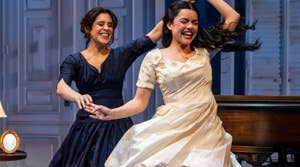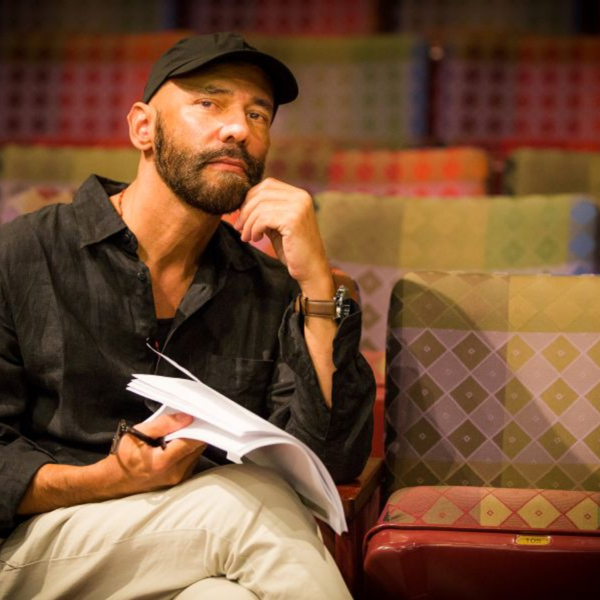
"People might think that my plays are about politics, but the politics are very simple. Two Sisters and a Piano is about two women who, even though they live in very harsh conditions, make the best of their lives. They create a little paradise in their house. Even though they are under house arrest, they bring out the beautiful china and use a tablecloth. It's the integrity of that, the dignity of it, that moves me."
Born in Cuba in 1960, Nilo Cruz immigrated to Miami, Florida with his family at the age of ten on a freedom flight. After becoming interested in the theatre as a young adult, he moved to New York to study playwriting with María Irene Fornés and then earned an M.F.A. from Brown University in 1994.
Two Sisters and a Piano began as a 30-minute work written for McCarter Theatre in Princeton, New Jersey for a 1996 festival of radio plays. McCarter commissioned the writer to expand the work into a full-length script, which was developed over the next few years. The play received its world premiere at McCarter Theatre in 1999 and opened in New York the following year.
Cruz's next play, Anna and the Tropics, became a breakout hit for the playwright, winning him the 2003 Pulitzer Prize for Drama—the first Latino writer to receive the honor. He has had many more plays produced since then, and also teaches playwriting. An opera he wrote the libretto for about Frida Kahlo and Diego Rivera will be produced this spring at Lyric Opera of Chicago.
Two Sisters and a Piano has had a resurgence in recent years. Cruz translated the play and produced a Spanish-language version in Miami in 2019. He also directed two new English-language productions—in New Jersey in 2023 and Miami in 2024—where he revisited the script and added some new material. The WT production will feature this newly revised script.
While working on Two Sisters and a Piano at Two River Theater in 2023, Cruz gave the following interview about the play.
What inspired you to write Two Sisters and a Piano?
The play is loosely based on the life of Cuban writer and activist Maria Elena Cruz Varela, who wanted changes and operated as an anti-Castro revolutionary within the system during the 1990’s. The moment in her life that most resonated with me was when the military went to her house, dragged her into the middle of the street and forced her to eat the manifesto her group had written. I was dumbfounded by the violence and humiliation inflicted upon her. In this play, I added the second sister to complement her – an artistic voice expressing the power of literature – the power of the word – and its seductive charm. The play also comes from a moment in my own life in 1991. I was in Morocco, at a bar in Tangier when I heard about the dismantling of the Soviet Union. I immediately called my mother to ask, “What about Cuba?” Like the two sisters, Cuba is far from the rest of the world – isolated, with no access. Alone.
Why should audiences come see Two Sisters and a Piano?
The play is ultimately about the power of imagination and the power of literature. Both offer such possibility to all of us. This play, which is one of my early ones, is almost a seed for my later play, Anna in the Tropics (Pulitzer Prize). The themes are repeated: How do we escape oppression? How do we use imagination to save ourselves, and keep our hope intact? What happened to Cuba in 1991 is still happening in Cuba – people want more freedom, and continue to search for a better place. Given our recent time in isolation because of Covid, aren’t these feelings we are all experiencing?
What is one of your favorite moments in the play?
At one point the lieutenant says to the main character, “I want to help you to stop waiting.” This, in my opinion, is love. In many ways, love is so remedial, but it helps us get to another place – embracing who we are and what comes with love. And what is the remedy for stopping the waiting? Loving energy that embraces reality – the salvation of waiting is faith in the intangible. And that’s theatre. All our lives, we’re taught not to cry or laugh too loudly, but theatre finally gives us the permission we desperately crave. Like the two sisters in my play, finally we can escape our own house arrest and free ourselves. This is why I’m in the theatre.