Written by
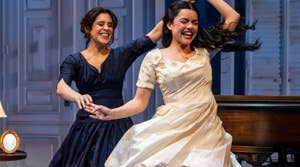
What would happen to Cuba if the Soviet Union no longer existed? As the 1980s ended and a new decade began, this question was asked again and again—inside Cuba and around the globe. Two Sisters and a Piano is set in the summer of 1991 when that long-pondered potentiality was quickly becoming reality.
Fidel Castro had been the leader of Cuba since New Years Day 1959 when embattled Cuban president Fulgencio Batista fled into exile. Castro’s revolutionary movement was immensely popular with the majority of Cubans and his government immediately pursued socialist reforms to Cuban society. The American government, which had previously backed the corrupt Batista, decided Castro was too radical, severed diplomatic relations with Cuba, and worked to undermine its new leader. Trade and tourism between Cuba and the United States had been robust, but a newly enacted and enforced American embargo ended it all.
In the wake of the Bay of Pigs disaster in 1961—in which a force of Cuban exiles, armed and trained by the CIA to instigate regime change, was routed upon landing on the island—Cuba drew closer to the Soviet Union to help protect itself from the possibility of a future American invasion. The country benefited immensely from the support of its communist benefactor, which was able to provide Cuba with both economic and military support. The Cuban economy was heavily concentrated on the sugarcane industry and had been since colonial times under Spain. In exchange for sugar purchased at above market prices, the Soviet Union supplied Cuba with almost all of the oil, fertilizer, grain, iron and automobiles it needed. Literacy rates in Cuba soared and higher education became possible for much of the population. Those Cubans dissatisfied with the country’s direction largely left during periodic waves of sanctioned emigration—with a substantial population of Cuban emigres making Miami, Florida their new home.
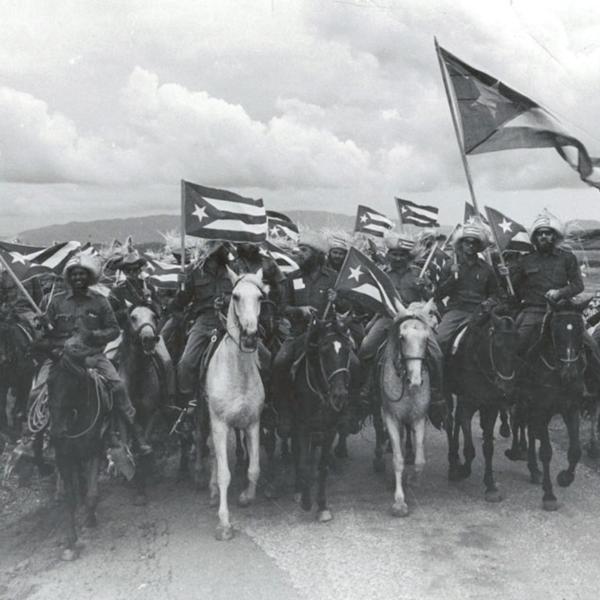
The stability of the Soviet-Cuban relationship began to unravel in the mid 1980s. Mikhail Gorbachev became general secretary of the Soviet Union in 1985 and launched a campaign of reforms which he believed would strengthen the struggling superpower. Glasnost was a commitment to more openness and transparency in Soviet government, and Perestroika was an overhauling of the communist economy with elements of economic liberalism. Castro disagreed vehemently with Gorbachev’s strategy, telling his countryman ''those inside the Communist Party who show themselves in favor of perestroika and glasnost are of the same clique as those dissidents out there and of counterrevolutionaries. We are not going to tolerate this deviationism.'' Instead, Cuba recommitted to strict communist ideology, launching “the Campaign of Rectification of Errors and Negative Tendencies” in 1986 to roll back the few elements of a market economy existing within Cuba.
Ties between the two countries grew increasingly strained as the ‘80s progressed. Gorbachev made an official visit to Cuba in 1989 as part of a show of unity, but the tension between the two leaders was noticeable. Glasnost had made public the glaringly unequal trade terms between the two countries, and Russians and Eastern Europeans began to re-evaluate those subsidies. Meanwhile, nationalist movements grew in Eastern Europe and within Russia itself. Poland pivoted from communism to democracy in June 1989 and several months later the Berlin Wall fell, paving the way for German reunification. The breakup of the Soviet Union seemed to be a serious possibility.
Cuba anxiously watched these events unfold, given their dependence on Soviet support. A campaign of austerity had been prepared in the event of a blockade by the United States, a plan referred to as the “special period in times of war.” By January 1990, Castro began referring to the possibility of a “special period in times of peace,” necessitated by the collapse of its largest trading partner.
With rationing increasing and further austerity looming, Cuba forged ahead with hosting the 1991 Pan-American Games in Havana. Athletes and dignitaries from around the western hemisphere—including the United States—would be arriving in Cuba, and the Castro regime was determined to present their country positively to all their visitors. The games proceeded successfully, and Cuba would end up winning more gold medals than any other country.
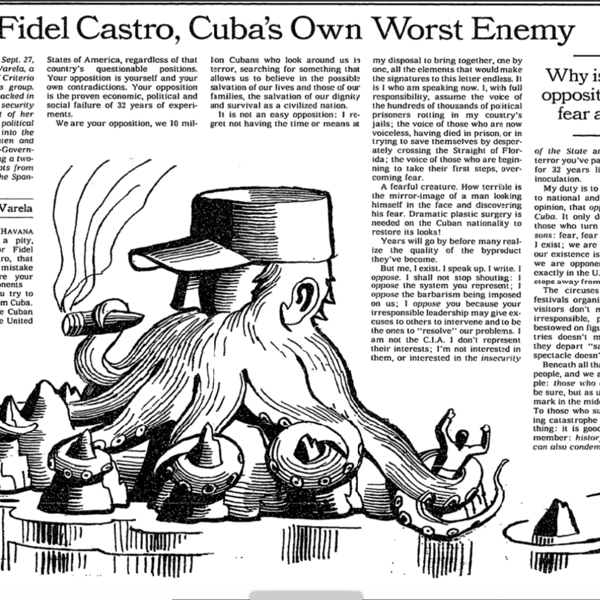
At the same time, some Cubans saw an opportunity. The world order was being shuffled, and activists and artists began to speak up in support of modernizing Cuba. Critico Alternativo, a dissident group formed by several prominent Cubans, including poet Maria Elena Cruz Varela, the recent winner of Cuba’s highest literary honor, published a pamphlet in 1991 calling for elections and democratic reforms. Cruz Varela also wrote an open letter, “Fidel Castro, Cuba’s Own Worst Enemy” which was later published in The New York Times.
A crackdown on the dissent was swift. Every neighborhood in Cuba had a volunteer Comites de Defensa de la Revolución (Committees for the Defense of the Revolution [CDR]), which assisted the police force and Interior Ministry in watching for counter-revolutionary activity. Their slogan was “¡En cada barrio, Revolución!” (“In every neighborhood, Revolution!”). As Anthony DePalma described in his book The Cubans: Ordinary Lives in Extraordinary Times:
“Cubans who dared to think differently feared more than anything else their ever-present neighborhood CDR. […] The CDR president had what some called the power of ‘fusilamiento del dedo,’ literally ‘to execute with a finger’ by pointing out and denouncing anyone suspected of counterrevolutionary activities, depending on how the regime defined such things at the time.”
A rapid response brigade of pro-regime Cuban citizens was summoned to Maria Elena Cruz Varela’s home and began a campaign of harassment against her, which she described in her book Dios en las cárceles cubanas (God in the Cuban jails):
“They broke my mouth trying to make me swallow the leaflets that members of my group had distributed throughout Havana. Afterwards I spent three days brutally besieged, imprisoned in my own home with my two children, with no water, no electricity, no food, no cigarettes. We heard what the huge speakers never stopped amplifying, allegorical songs to the country, the necessary punishment of traitors, and anyone who wanted to could shout at me, organized, of course, the slogans they pleased: Comrade worm, we are going to execute you by firing squad!”
A week later, Cruz Varela was arrested and then sentenced to two years in prison for illegal association and defamation. A year and a half later, she was released to live under house arrest. In 1994, she left Cuba to accept a literary award in the United States, and never returned. The character of Maria Celia in Two Sisters and a Piano was inspired by Cruz Varela.
The Pan-American Games concluded in Havana on August 18th, 1991. That same day, several members of Soviet president Gorbachev’s cabinet attempted a coup to stop the further decentralization of the Soviet Union. Gorbachev was held hostage by KGB agents, but resistance by Russian president Boris Yeltsin and civilians undermined the coup within days. From there, the breakup was swift. The Baltic states and Georgia broke away into independent countries in September. Russia, Ukraine and Belarus began talks to enter into a new Commonwealth of Independent States. On Christmas Day, in a television address, Gorbachev formally resigned his position. The Soviet Union was no more.
Ada Ferrer describes the impact the demise of the Soviet Union had on Cubans over the course of the ‘90s in her Pulitzer-Prize winning book Cuba: An American History:
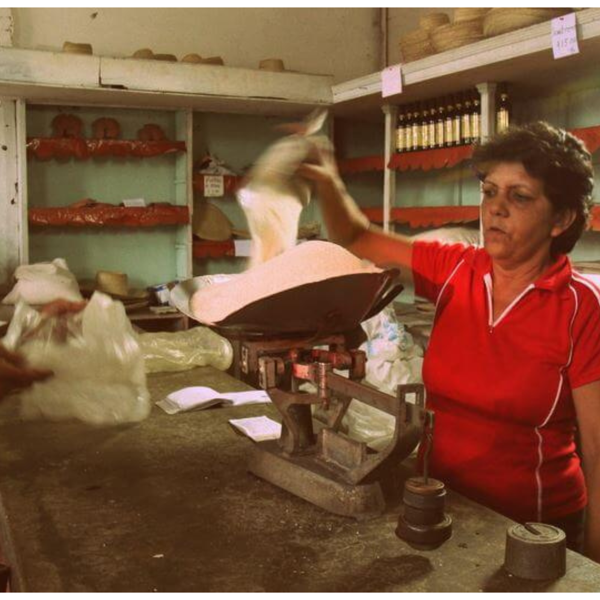
“In all aspects of life, Cubans lived the collapse of the Soviet Union with every cell in their being. The daily consumption of calories dropped on average by a third. Dietary staples for thirty years—Russian canned meat, Bulgarian canned vegetables, German sausage—all disappeared. Two hundred consumer products were added to lists of rationed items, and allowances of rationed goods were drastically cut. The new quota of fish was now two servings a month; of coffee, four ounces. Milk, which had been allotted to everyone, was now reserved only for children under seven. […] On average, families—mostly women—spent fifteen hours a week on line waiting to buy food, reducing time for leisure. But book publishing and television programming had been reduced by half to conserve paper and fuel, so there was less to do in that regard anyway. […]The lack of petroleum meant also that the country grew dark. […] Power outages were so constant that Cubans joked that they had alumbrones (light-ins) rather than apagones (blackouts). Indeed, Cubans developed a whole vocabulary for the country’s state of crisis. No es fácil—it’s not easy—took on the character of a verbal tic, used to start conversations, to end them, to transition from one topic to another, to fill an awkward pause.”
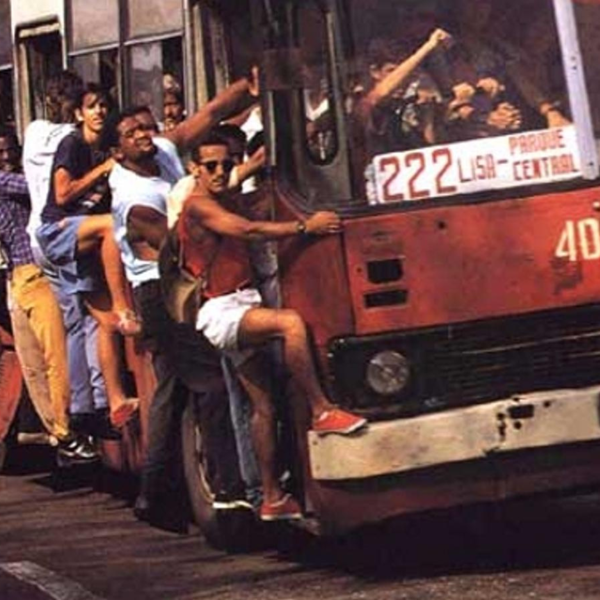
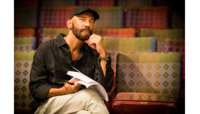
The Special Period in Cuba would last the remainder of the decade until increased tourism and the support of Venezuela’s Hugo Chavez provided new revenue streams and economic subsidy. The opportunity for reform that pro-democracy activists thought might be possible never materialized. Fidel Castro remained in power until 2008, and Cuba remains a communist state to this day. With the recent regime change in Venezuela, speculation over “what is going to happen to Cuba?” abounds again. It’s a question that playwright Nilo Cruz has been asked many times in his career, and he had this response in a 2017 interview with BroadwayWorld:
“It's interesting, I've been seeing this closing and opening of doors with Cuba ever since I was a child. […] When you get a glimmer of hope that things will thaw immediately ... nothing happens. It's curious, I sort of document that in my play Two Sisters and a Piano - nothing really happens. All these things are happening across the world, the thawing of the Soviet Union, but nothing happens in these women's lives who are incarcerated. The incarceration in Two Sisters isn't just the literal incarceration of two women who are under house arrest, but is really a metaphor for Cuba. Cuba is sort of a prison. Whether it is the ocean or it's the ideology, that communist ideology, that imprisons the island. It's something that I do play with in that play, and still, Cuba is in the same- nothing has changed. It's still the same.”