.png?w=600&h=600)
Written by
The first time I read Max Wolf Friedlich’s JOB, I was sitting on the floor of my brand new office, making do with some floor cushions while I waited for my couch to be delivered. (You might come to understand, as you watch the play, why this was ultimately an unnerving experience.) I’m a therapist in private practice in addition to my work as a writer, director and dramaturg. Sometimes, balancing these two careers feels like leading a double life. It can be hard to reconcile one job, which asks me to set myself aside in service of meeting the needs of my clients, with the other, which hangs on my ability to find and nurture my own voice and perspective. One job is, by definition, public while the other is necessarily private. One demands consistency while the other thrives in chaos. Some days, it feels like I have to choose a path, like these two sets of truths can’t possibly exist at the same time — and then a play like JOB comes along.
In 1961, the psychiatrist Robert J. Lifton coined the term “thought-terminating cliché” to describe easily memorized phrases intended to halt critical thought and prevent further discussion. We see this tactic used all the time — in politics, on social media, in that Netflix true-crime cult exposé you can’t stop binge watching, and in day-to-day life, where pat phrases like “don’t rock the boat” or “boys will be boys” run rampant in classrooms and on playgrounds, robbing us of the chance to question and consider the particular impact of a particular action. In a more extreme example, Jim Jones of the Jonestown cult relied on phrases like “trust the plan” and “it’s out of our hands” to convince members to comply with his plans ahead of the infamous mass murder-suicide in the fall of 1978.
Thought-terminating clichés prey on the difficulty that many of us have tolerating cognitive dissonance, or the mental discomfort that comes from holding two or more opposing beliefs at the same time. Our minds, especially when we have experienced trauma, crave simple, clear, definitive and, yes, thought-ending answers to life’s most complex questions. We hear “everything happens for a reason” or “it is what it is” and feel some semblance of control. We hear words like “liberal,” “conservative,” “religious,” “queer,” “boomer,” “gen-z,” “millennial” and make sweeping assumptions about a person’s character. We hear a phrase like “jack of all trades, master of none” and question our career choices. We think we can outsmart uncertainty. We think this will keep us safe — which might be why, in this time of increasing isolation, of economic, environmental and political insecurity, of “no-contact” and “cancel culture” and funding cuts and AI and widespread global unrest, we are turning to the hotbed of the thought-terminating cliché: the internet.
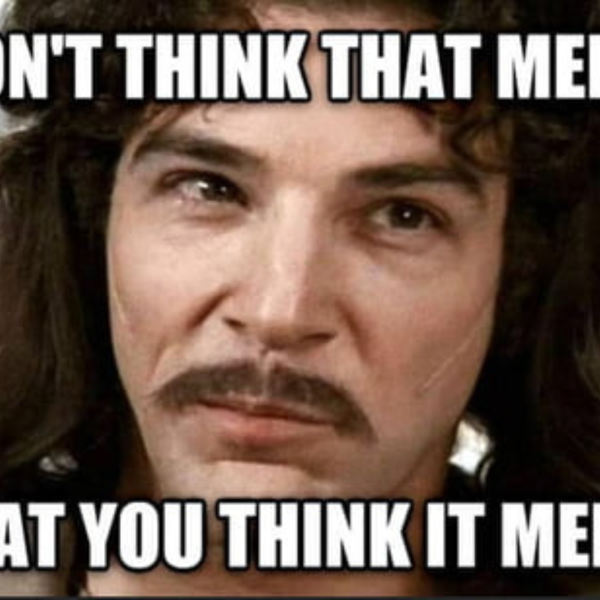
In his book, Stolen Focus: Why You Can’t Pay Attention — and How to Think Deeply Again, Johann Hari interviewed more than 200 experts on the science of attention. While he notes that the internet is not the only thing at fault, the speed at which the internet moves has reshaped our brains to favor shallow processing over deep concentration. These changes are also reflected in our communication, from letters and phone calls to emojis and memes, in which images and videos are explicitly decontextualized and meaning is made in 0.5 seconds, which is roughly the amount of time it takes the brain to process and interpret stimuli. As psychology PhD student Korab Idrizi says, “Memes reduce ambiguity into clarity, [compressing] complex realities into a single striking image. … They carry the illusion of insight, [satisfying] the human craving for definitiveness in a world that feels increasingly uncertain. … Memes are not the enemy. But when they become our only way of understanding, they rob us of the very thing that makes thought transformative: the struggle.” The discomfort is the point. The discomfort is where we grow.
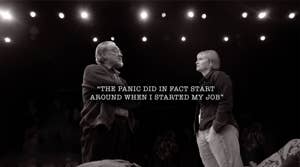
The two characters in JOB might seem oppositional, particularly (especially) at first glance: Loyd, a hippie-esque therapist in the boomer range, and Jane, a millennial tech employee. If you plug these two character descriptions into ChatGPT, I guarantee you’ll find a mountain of thinkpieces and phrases like “mutual animosity” and “culture war.” It would be easy enough to write and produce a play about these two characters coming together, crossing the generational divide, proving once and for all that all we need to do is to listen to each other, to find our common ground, to set our differences aside in the name of unity. But JOB isn’t quite that simple. More than just a call for connection, this play is a cry for help; a plea and a practical exercise in service of our ability to tolerate ambiguity, to relinquish the false control of a closed loop and instead, meet the world as it is: complex, unwieldy, often without answers, and deeply worthy of our attention