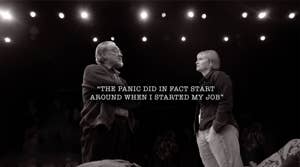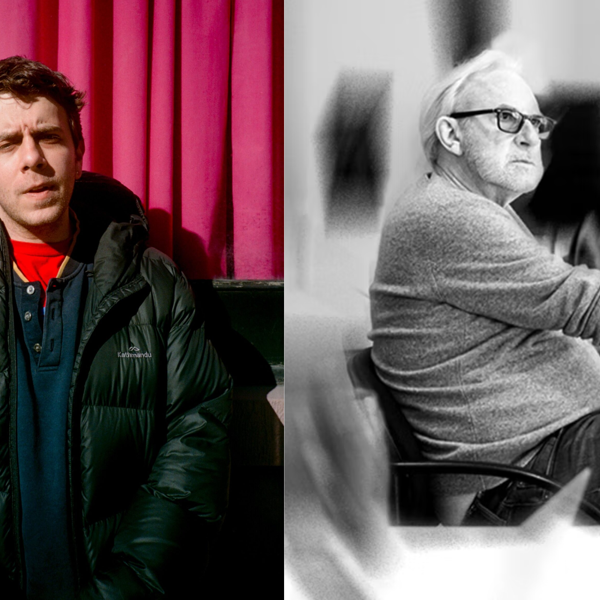
For this Chicago premiere production, director David Esbjornson and playwright Max Wolf Friedlich have been in dialogue throughout the pre-rehearsal process, and Max joined David and the cast for a few days of rehearsal on site. We asked them a few questions about their collaboration while Max was here at WT.
Max, what made you want to come to rehearsal and be involved in the WT production, given the play is now published and having a life of its own?
Max: I don't think plays are ever done. Intrinsically, they're never sort of finished and they're never stagnant. I am a big fan of David's work and Writers Theatre looms large in my imagination, and when I found out who these actors were and their pedigree.... I'm here just as a lover and appreciator of theater. I was excited to watch David work and excited to be in dialogue and conversation with him.
David: It never occurred to me not to reach out and connect because as I tell a lot of younger people: the playwright, that's the source. That's where you get your great information. And if you're lucky enough to have them, that they're contemporary and around, it really behooves you to get them into the rehearsal process, especially early on. There comes a time when you do need to work more privately because you've got to fumble around and make some mistakes, and you can be kind of self conscious if you're doing that in front of the person you want to impress the most. But I also agree that plays are not done. They're living things and they have to respond to the people that are working on them. The text doesn't change radically usually, but we've even talked about a few things and a few adjustments. Not major ones, but to be able to turn to the writer and say, “Is it okay if we do it that way?” is fantastic.
What was the inspiration for the play?
Max: I met someone at a house party in 2018 who had this job as a content moderator, and she seemed pretty visibly unwell. I approached her and asked if she was okay. It was like seeing someone kind of standing a little too close to the edge of the subway platform. And she told me about this job, which I had no awareness of as a terminally online person. I had no awareness that there was this human labor cost that went into allowing me to scroll mindlessly on my phone. And I felt really stupid and sort of angry at myself for not knowing that. So that was sort of the first point of inspiration. Increasingly, the play drew from this job I had straight out of college, writing for this fictional Instagram personality named Lil Miquela. I had this experience of being quite famous and completely anonymous on the internet, and also this circuitous experience of being a famous 19 year old girl on the internet and experiencing some iota of what that is like. Some of the elements of the play that seem the most fictional are actually the things that were closest to what I experienced, and some of the things that are more pedestrian like being from Wisconsin are not my experience.
David, what sorts of things did you want to talk to Max about when you first connected?
David: I wanted to know whether he liked the idea of this really tight space. I wanted to know if he was okay with the idea of the audience mirroring each other for one thing. Because I knew that wasn't the situation in New York.
Max: We said this is not the world premiere but it feels like it is in the sense. Most playwrights get their introductory “Hi, this is me” production via nonprofit theater where they don't have to think about where they're gonna source the art on the walls or if we're gonna need more lights. We were self-producing all the way through the first productions of JOB in New York, and we were always moving out of a utilitarian need to just sort of make it work. So the opportunity to come in and to hear David be like, “this is my vision for it,” and we are cool to do that and don't have to recruit our friends on the weekends to help build that. Which is again sort of the odd contradiction of my process in getting here. People are kind of like, oh the New York production. I'm like, the New York production? Where we were literally going to fabrication places and asking for wood that they were throwing away? I did not have a glamorous New York debut.
David: When I started out, I was exactly the same. I would self produce with other actors or other people. Even when I was given my first opportunity at New York Theatre Workshop, there was no money. So I was running around and dragging a toilet six flights up to my apartment and holding it there because it was the perfect toilet for the show. You find yourself doing these very, very weird things. You're looking in dumpsters for stuff that might be cool, that might either inspire you or that you can use in your production. With Writers Theatre, it is true that we are supported, and that's fantastic. But having run theaters myself, I thought maybe the advantage of doing this on a postage stamp is that we can put all of our energy and all of our resources into a small amount of space. Which I think is right for the play, but we can also provide an interesting experience for the audience by doing a different kind of platform for them. So that everybody’s looking at it, and you're looking at people looking at it.
It's been two and a half years since the play premiered, and six since the year it is set. So what do you find that it's still continuing to say about our relationships with technology, other people?
Max: I'm working on a television show right now that's about AI and tech, and so I talk about sort of the worst-case scenarios a lot of the day, about people who are in a relationship with a chat bot or are letting an AI run their financial situation. So JOB already feels like way more of a snapshot of a time and place. Already the world and the internet of 2020 feels like a distant memory compared to what is happening now. Right now we're experiencing sort of a death of social media and certainly the death of veracity and truth has already happened. I think now it's this weird Demento version of the death of fiction, where nothing appears fictional to people. It's a symptom of a digital native generation. There was this moment with Trump where we were like nothing is true anymore, everything is fiction. And now it feels like the generation behind mine is engaging with everything as real, which is the other side of the coin of everything is fake.
David: Do you think it's worse that fiction feels like truth or the other way around?
Max: I think, I think they're both pretty bad in their own ways. For what we do, I think fiction feeling like truth is pretty awful. People can't make a distinction. It leads to a level of engagement with things that is really unhealthy. Where people are getting angry at a play and it's just like it's not real. The internet facilitates this sort of death of authorship, right? Where it's like once you say something and it enters a digital space, it doesn't matter. Intentionality doesn't matter. It also doesn't even really matter that you said it; it doesn't belong to you anymore. Everything is imbibed through one channel, generally, now. I mean, you used to turn on the news and know I'm watching the news. You used to flip to the reality TV channel and go, now I'm engaging in the reality television space. Here's a sitcom. And now everything comes at you through one channel. The channel used to contextualize it and also kind of give you a little bit of "Hey, we know what this is." Don't get too upset about Jersey Shore. We understand that this is ridiculous. We're not asking these people to run for office, you know?
David: Whereas what theater does is it sort of triggers ideas, it triggers thinking, it allows you to participate emotionally in something that's difficult safely. The reason we watch it up there is so we don't have to have that horrible experience. Not that everything on the stage is horrible, but we can separate our own lives from that, and still have a sense of what that means. And that's how we understand other people, through the theater.
Max: I think it's net good for theater, to be honest, because I think the theater is gonna feel more and more special. And real.
.png?w=200&h=114)