Written by
As You Like It is a story of transformation.
Characters who were once respected members of society become refugees in exile. People happily single later end up married to a kindred spirit. The setting and scenery change from the royal court to the Forest of Arden. And hearts, minds, opinions and outlooks all also end up reshaped by the final curtain. It is only fitting, therefore, that the way this story is told would have also changed dramatically over time.
Early Inspiration
The Tale of Gamelyn, a Middle English romance from the 14th century, provides some of the basic story elements that would eventually find their way into As You Like It. The poem’s 900 lines tell the story of a younger brother who, upon the death of his father, is denied an inheritance by his evil older brother. Gamelyn ends up escaping to the woods, joining a band of outlaws, and fighting to obtain what is rightfully his. Stories about outlaws in the woods were immensely popular at the time; the first written references to Robin Hood date to this period as well. The Tale of Gamelyn was included in some early manuscripts of Geoffrey Chaucer’s The Canterbury Tales, although later scholars concluded the work was not Chaucer’s.
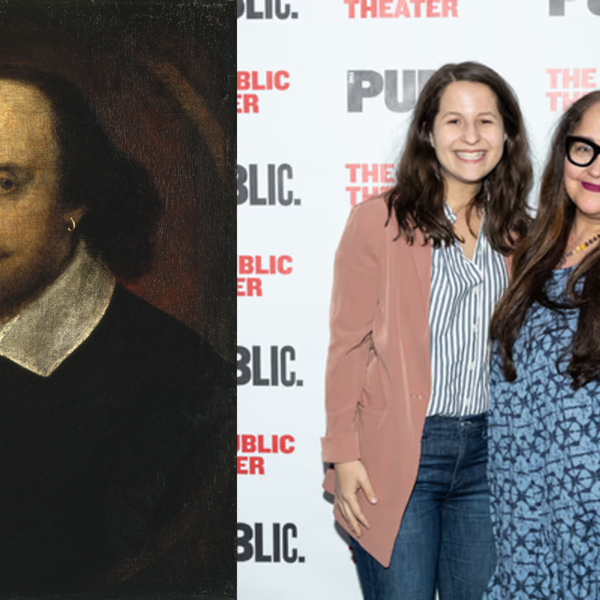
Two centuries later, the English writer Thomas Lodge incorporated the disinherited and exiled brother story into a novel he was writing while on a voyage to the Canary Islands in 1586. Lodge invents some of the most familiar elements Shakespeare would end up borrowing: an exiled ruler living in the Forest of Arden; the triptych of romances among the core characters; and Rosalind disguising herself as Ganymede. The narrative is written in a style fashionable to the Elizabethan era called Euphuism, derived from the Greek word “Eupheus” (εὐφυής), meaning graceful or witty. Published in 1590, Rosalynde; or, Euphues' Golden Legacy was a hit with the public and by 1642 had been printed eleven times already.
Shakespeare's Play
Within a decade of the publication of Lodge’s Rosalynde, Shakespeare was using it as inspiration for a play of his own. As he did with other works adapted from existing sources, the playwright made many changes for his version: several main characters were given new names (Rosader became Orlando, Saladyne became Oliver, Alinda became Celia); the duke in exile and the one who had usurped power became brothers; and much of the supporting cast (including Jaques and Touchstone) were added.
When As You Like It was first performed isn’t clear. It was included in an entry of Shakespeare’s plays in the Stationers’ Register in 1600, along with Henry V and Much Ado About Nothing. A previous entry from 1598 did not include the play, so it must have been more recently written. No quarto publication of the play exists, surprisingly; its first appearance in print was as part of the First Folio in 1623.
Performances of the play were relatively few during the 17th and early 18th century. When the play was produced, it was often heavily adapted. Productions of the unabridged text surged in the late 1700s, as Rosalind became a favorite role for leading Shakespearean actresses. The play was produced more than any other of Shakespeare’s between 1776 and 1817 at London’s Theatre Royal, Drury Lane. The Forest of Arden became a favorite location to realize for theatrical designers, and the play lent itself well to composers to add original music to productions.
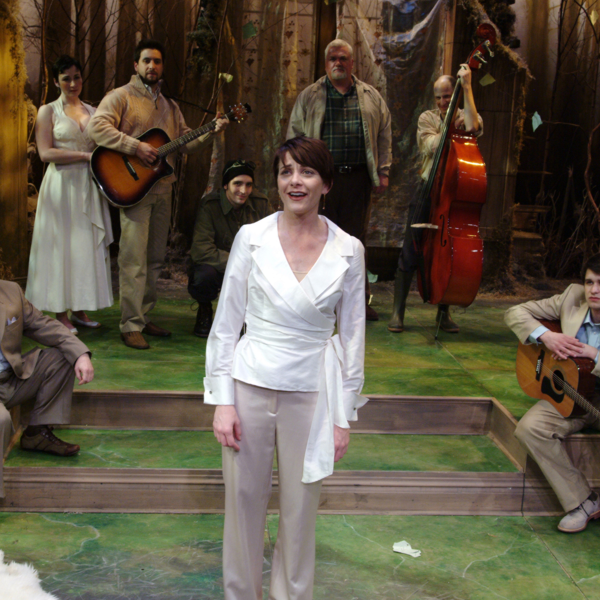
The popularity of As You Like It continued through the 20th century with many leading actors of their time taking on its beloved roles. Katherine Hepburn starred as Rosalind in the longest-running Broadway production of the play in 1950. Ten years later, Vanessa Redgrave played the role in a lauded production at the Royal Shakespeare Company, which has staged major productions of the play usually once or twice a decade since then. There have been productions where Arden is depicted as lush forest with running water and some where it is composed of plexiglass tubes. Kenneth Branagh set his 2007 film version in imperial Japan, which won Kevin Kline a Screen Actors Guild award for his performance as Jaques. Long-time attendees of Writers Theatre may remember a 2008 production of the play here in our previous venue in the Woman’s Library Club of Glencoe. Directed by William Brown, the Chicago Tribune called it “a contemplative, elegiac piece that is as wise and mournful as it is sprightly and amusing.”
Taub & Woolery’s Musical Adaptation
In 2013, New York’s Public Theater announced the creation of a new community engagement program titled Public Works. Working with partner organizations in all five boroughs of the city, Public Works invited New Yorkers to play a role in creating a participatory theatre event that would perform for free in the Delacorte Theatre in Central Park at the end of each summer’s Shakespeare in the Park season. The program was the brainchild of Artistic Director Oskar Eustis and director Lear DeBessonet. The pair decided that a large-scale Shakespeare production featuring original songs was the perfect vehicle for a pageant-style performance featuring over 200 professional theatre artists and community members. DeBessonet and composer Todd Almond collaborated together on the first three Public Works productions:The Tempest, The Winter’s Tale, and The Odyssey.
For the 2016 season, new Public Works directors Kwame Kwei-Armah chose to collaborate with performer/composer Shaina Taub. Taub had performed in the off-Broadway casts of the musicals Natasha, Pierre and the Great Comet of 1812 and Hadestown and was a budding songwriter in her own right, contributing songs to the 2014 off-Broadway play Old Hats and releasing her debut singer/songwriter album Visitors in 2015. Kwei-Armah and Taub picked Shakespeare’s Twelfth Night for their Public Works debut, with Taub composing the music and playing the role of Feste. Laurie Woolery took over as Director of Public Works in 2017, after having been the program’s Associate Director since its inception. Having watched Taub's work on Twelfth Night, Woolery was eager to work with her on another musical adaptation of Shakespeare and the two quickly settled on As You Like It. Speaking about what drew her to this particular Shakespeare play, Taub said:
“The line between reality and fantasy was really big for me. Reality and magic and where those meet. There’s the fantasy of the role we feel like we have to play in life and the idea of ‘all the world’s a stage,’ and then we’re all kind of moving through life with the prescribed set of behaviors that we feel are put upon us, and in our journey as people we strip that away and figure out who we really are. Trying to lessen the gap between how the world sees you and how you see yourself. [In As You Like It] both in the macro way—in terms of all the refugees that are out in Arden that have been banned from the court—and then with Rosalind, who’s spent her whole life playing this role of this woman she felt she had to and stripping that away to see what’s really underneath.”
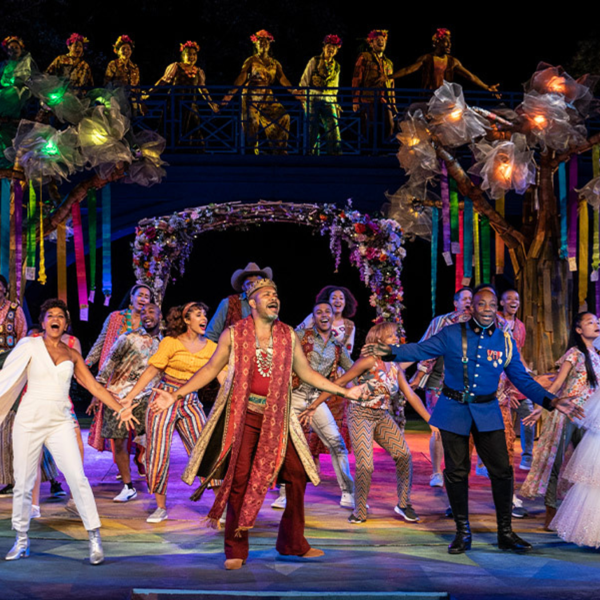
Taub and Woolery’s musical adaptation of As You Like It premiered in September 2017 with a short run of free performances at the Delacorte Theater. Over 200 New Yorkers appeared on stage each night to populate Arden and bring the story to life. The New York Times commented that “with its varied cast and its lilting confidence in basic human decency, this As You Like It offers a utopian vision of a society that favors acceptance over division, honesty over obfuscation, grace over meanness.” Stagings of both of Taub’s musical adaptations of Shakespeare have proliferated in the years since with some productions continuing the Public Works model of participatory theatre.
The Public chose to revive As You Like It for a Public Works encore in August 2022. By then, Taub’s star had risen ever higher. She had contributed lyrics to go with Sir Elton John’s music for a musical adaptation of The Devil Wears Prada. And The Public had earlier that year premiered a new musical with book, lyrics and music by Taub called Suffs about the suffragette movement. Two years later, Suffs moved to Broadway and Taub won Tony Awards for Best Book and Best Score—making her the first woman to win both of those awards.
.png?w=600&h=600)
On to a New Stage
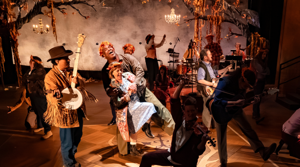
The transformations continue with As You Like It as it comes to the Writers Theatre stage. Artistic Director Braden Abraham previously programmed a production of the musical at Seattle Repertory Theater using the Public Works model of community participation. For this new production, Abraham is embracing an ensemble of purely professional performers, some who are veterans of past WT productions and many who are making their debut here with this show. Many of the cast members will also play instruments, and Music Director Michael Mahler has done a refreshment of the orchestrations, customizing the sound of these lovely songs expressly for the intimacy of the Nichols Theatre. The court and Arden will also take inspiration from the history and geography of our Chicagoland locale.
Whether this is your first time seeing any version of As You Like It or if you’re a Shakespeare fanatic, as the Ardenites sing in the musical, “All are welcome here!”
.jpg?w=200&h=114)


.png?w=200&h=114)