.jpg?w=600&h=600)
Written by
As You Like It plays out in only two locales: the royal court of the newly empowered Duke Frederick, and the Forest of Arden where the exiled Duke Senior now resides.
When asked about how he approached the design for this production, director Braden Abraham explained “I wanted a sense of an American iconic landscape in a place that also felt familiar to audiences seeing the show. I wanted to make a clear statement about the separation between urban and country life. So I decided to set it loosely in Chicago of the 1920s. The court will be in the city and Arden will be the Illinois prairie.”
Shakespeare's Court and Arden
Shakespeare specifies no exact city or country for these locations. The court setting is a familiar one and operates similarly to other Shakespeare plays featuring a Duke, such as The Comedy of Errors and Measure for Measure. Arden proves itself more open to interpretation. As Shakespeare scholar Michael Hattaway explains, a “'forest' in Elizabethan times was a legal term as well as a topographical description. [It] designated a domain preserved for the noble sport of hunting. Moreover, such forests were not necessarily expanses of woodland but could include pasture, as well as sparsely inhabited tilled and untilled terrain – England in Shakespeare’s time was, in fact, not much more forested than it is now.”
By naming the forest Arden, Shakespeare is also inviting an ambiguity of place. There was a forested territory in the West Midlands of England, south of present-day Birmingham and north of Oxford and the Cotswolds, named Arden. But there is also the Ardennes, an extensively forested region in present day Belgium and Luxembourg that crosses the border into France and Germany as well. But then of course neither England nor northern France are known for their lions or olive trees. This leads Hattley to the conclusion that “whenever we encounter the word [Arden] we must remember that it is an imaginary location, as ‘French’ as it is ‘English,’ as fantastic as it is familiar.”
No matter where Arden is located, in every production of As You Like It there will be inherent contrasts between the two major locations. “The court is a place that’s restrictive. Duke Frederick retains rigid control and a sense of power,” comments Abraham. “Whereas Arden is a place where social restrictions and the sense of hierarchy can melt away and people can relate more on a personal level. It’s also subversive in its egalitarian bucolic influence. Really everything is up for grabs and people can be more in control of their own destiny in a way they couldn’t at the court.”
1920s Chicago
So why Chicago and why the 1920s? “This period really embodied a lot of the qualities in the Shakespeare,” explains Abraham. “Chicago was a place of opportunity and a mixing of cultures and identities. But it was also a place that was tribal and violent.”
By 1920, Chicago had grown from a small swampy outpost of 4,000 residents in 1837 to the nation’s second largest city with 2.7 million people calling it home, a period of exponential growth unmatched by anywhere else on the planet. An early hub for the nation’s growing railroad industry, Chicago’s connections to both the agricultural heartland and the Mississippi River secured its importance to the nation’s economy. During the Civil War, Chicago was instrumental in supporting the Union while far enough away that it was unaffected by any fighting. More industries began to set up operations in the city, making Chicago a hub for meatpacking, steelmaking, manufacturing, finance and transportation. Even with the devastation of the Great Fire of 1871, the city outgrew its midwestern rival, St. Louis, by 1880 and overtook the much older east coast city of Philadelphia by 1890.
The first wave of a Great Migration of African Americans from southern rural areas to northern industrial cities began in the 1910s. The Chicago Defender, established in 1905, saw its distribution climb to somewhere north of 130,000 by 1919, with most of its readership in southern states. Chicago became a magnet for Black Americans looking to leave the south. Restrictive covenants meant more and more of the new arrivals were settling into concentrated areas on the city’s near south side. By 1930, more south side neighborhoods including Grand Boulevard and Washington Park had majority Black populations. This “Black Metropolis” or “Bronzeville” achieved national notoriety as a cultural and economic hub, home to such luminaries as Gwendolyn Brooks, Richard Wright, Louis Armstrong and Ida B. Wells.
The ‘20s were an iconic decade for Chicago culturally. Jazz exploded in popularity across the country, and Chicago emerged as a top market for musicians. Grand movie palaces were built all over the city. Over 100,000 people a week attended live shows and movies at popular downtown venues including the Chicago Theatre, the Oriental and the McVickers. The Uptown neighborhood on Chicago’s north side became a thriving entertainment district as well, with the Riviera Theatre opening in 1917, followed by the enormous Uptown Theatre in 1925 and the Aragon Ballroom in 1926. Two other still existing architectural landmarks, the Chicago Board of Trade and the Merchandise Mart, also began construction in the ‘20s.
The '20s were also when Chicago acquired some of its less savory calling cards. Prohibition offered organized criminals a robust business in distributing alcohol clandestinely. The gangster Al Capone relocated to the city during this time and began to build his empire. Violence between warring gangsters escalated throughout the decade, culminating in the 1929 St. Valentine’s Day Massacre. Tensions between different ethnic and racial groups continued to fester as well. Historian Dominic Pacyga writes in his book Chicago: A Biography, “Chicago had long been the destination for wave after wave of immigrants primarily from Europe, as well as the Middle East and Asia. Though not always welcome—Chicago was the home of much anti-immigrant, anti-Catholic, and anti-Semitic behavior—immigrants nevertheless created a home for themselves on the southwestern shore of Lake Michigan. By the beginning of the nineteenth century, immigrants had made their way across the cityscape and created viable neighborhoods. In 1910, the foreign born and their children made up almost 80% of Chicago’s population.” By 1920, 100,000 Black residents were calling Chicago home as well. A race riot ignited in 1919 when 16-year-old Eugene Williams was killed when he swam into a whites only section of 29th Street Beach.
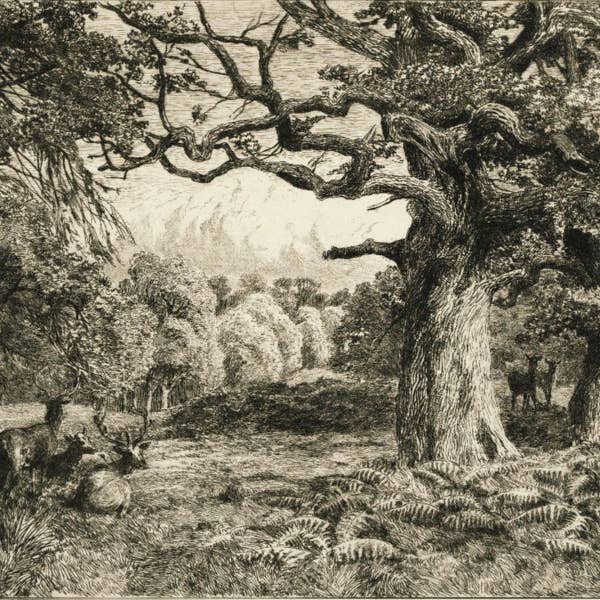
Prior to settlement by Europeans, Illinois’s landscape was mostly tallgrass prairie where the soil was especially rich because of ample rainfall and centuries of fire and grazing by large mammals such as bison, elk and deer. Wooden plows weren’t able to cut through the dense prairie soil effectively. It wouldn’t be until the invention of the steel plow by Illinois blacksmith John Deere that the prairie could be tamed. And tamed it would be, with less than .09% of the prairie that existed prior to modern agriculture remaining.
The Court and Arden at WT
WT's Court and Arden
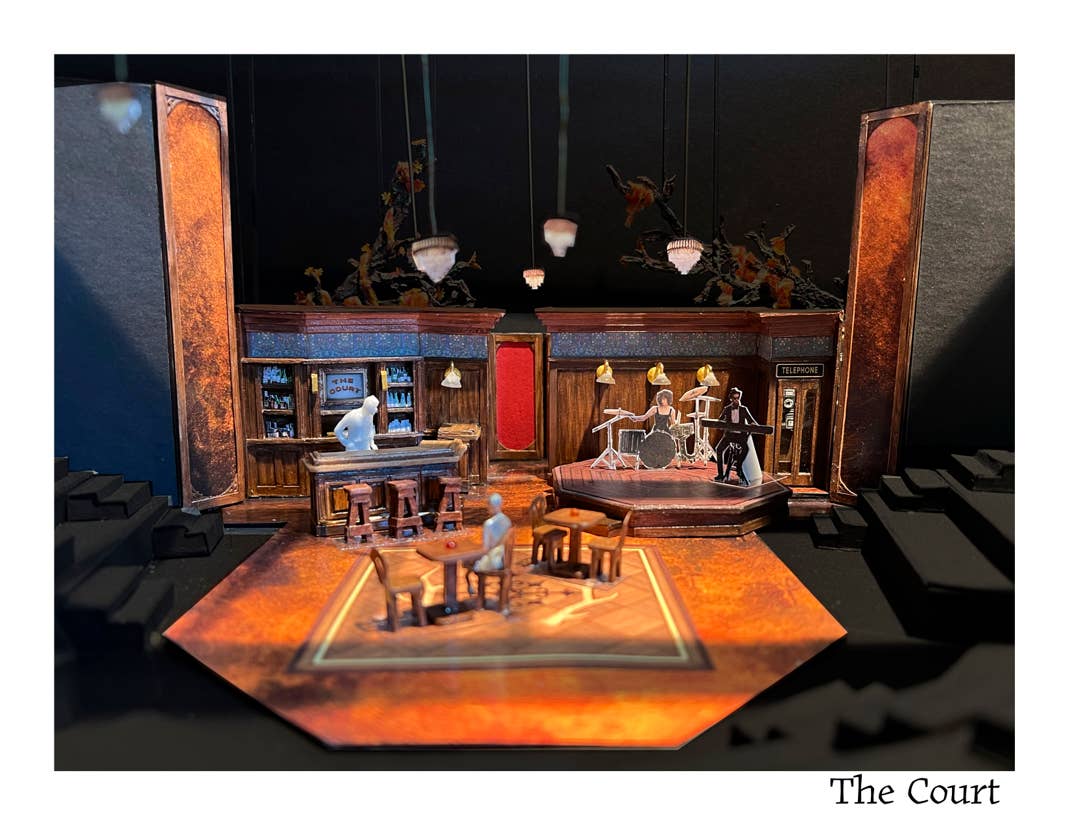
In the Writers Theatre production, the Court will evoke the look and feel of an iconic Chicago tavern. The Green Mill in Chicago’s Uptown neighborhood served as one point of inspiration for the scenic designers. “This is a place for social gathering,” explains Abraham. “On the surface everybody’s having a good time, but it’s also a place of corruption, where things are happening below the surface. Deals are being made in the background. You feel like something more is going on than what you see out front.”
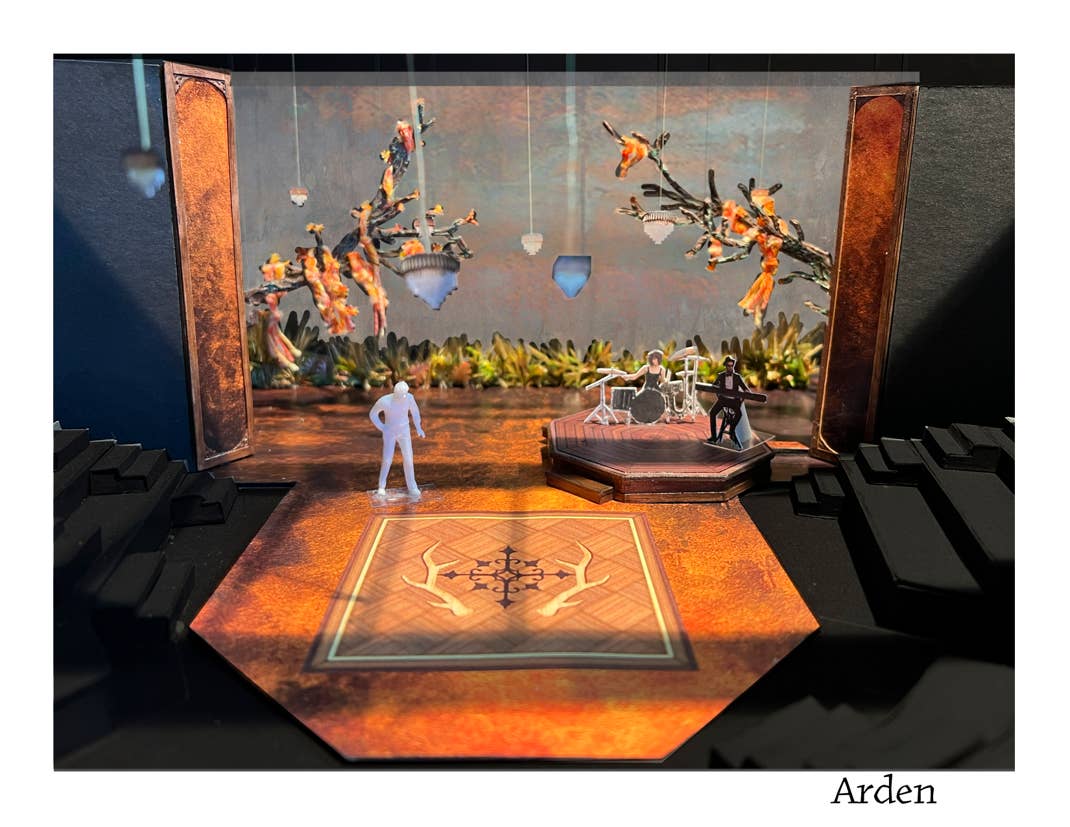
When Orlando and Rosalind are exiled, they leave Chicago’s urban jungle for the prairie landscape surrounding it. “Here the trees are adorned with beautiful fall colors,” elaborates Abraham. “We’ve moved from a place of confinement with low lighting to a wide-open landscape with sunlight. The sense of openness on the prairie comes with a sense of vulnerability. So many of the Arden scenes are of courtship. As people are opening their hearts, I wanted to see them in a place where there is nowhere to hide.”
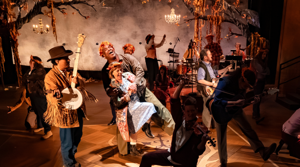
One element that remains constant is the band. Musicians will be onstage the entire performance. Additionally, audiences can order beverages before the show from the onstage bar and mingle with each other on the tavern set. “I wanted to embrace there being no barriers in the space, that immersive quality we like to do here at WT,” Abraham affirms. “That feels incredibly right for this play which has always had a spirit of participation.”



.png?w=200&h=114)