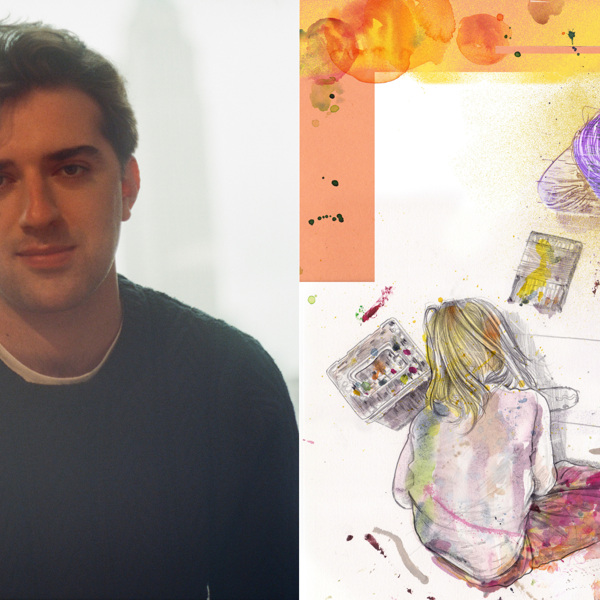
Prior to the start of rehearsals, playwright Matthew Libby spoke about his passion for plays about technology and the inspiration for Sisters with dramaturg Bobby Kennedy.
Bobby Kennedy: What's your origin story? How'd you come to be a playwright?
Matthew Libby: I've always loved theatre. I acted in plays and musicals throughout my childhood, and, growing up in LA and regularly visiting New York with my family, I was lucky to see a lot of amazing theatre on both coasts from a young age. I was writing plays through middle school and high school, but for college, the advice that I got at the time from some mentors was that the only thing more important than knowing how to write is having stuff to write about. Their advice was grad school will always be there. You're 18 years old, go study the things that are exciting to you and then write about those things. I ended up at Stanford, and I went in thinking I was going to be a psychology or creative writing major, but then I ended up, as a lot of people at that school do, falling into computer science. I never seriously thought I was ever going to go work in tech long term, but I really liked the way that the computer science classes I was taking were connecting to my psychology curriculum. And so I fell down this rabbit hole and towards the middle of my sophomore year, I looked up and I realized I was halfway to a cognitive science degree. So I ended up majoring in that, but I was always on the lookout for ways to pursue the arts extracurricularly. In my senior year, I came across this opportunity, which was a way for non-arts majors to get academic honors by doing an arts thesis… but only if the project is about their major. Which forced me to think — how is cognitive science dramatic? And for me, the question that I became very interested in is: What is innately human in a technological world? What makes me me, and you you, and all of us one and the same? That is both a question at the core of cognitive science, and I also found it to be a very dramatic, interesting human question. So coming out of undergrad and into grad school, I started thinking about that as my area of interest as a writer.
BK: What is it you enjoy about the juxtaposition of being in a live theatre experience and then telling us a story about digital technology?
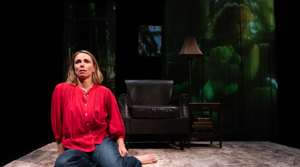
ML: Because theatre is the medium of language, one of the things it’s really good at is giving the audience a vocabulary, a way to talk and think about issues out in the real world. And when it comes to tech, whose whole business model is based around hype and jargon and users not understanding how products work, I think having a vocabulary to look inside the black box is crucial. And in my eyes, the way that vocabulary becomes meaningful to an audience is by having it not really be about tech at all. I love writing plays about tech that really aren't about tech. In Sisters, the whole point of it is that you never see any tech on stage. We're not trying to anthropomorphize the tech or make you think about how Greta works. The thing that I'm interested in is the more analog human question of what does it do to the individual? What does it do to the human? Again, the question that fascinates me: What does it mean to be human in an increasingly technological world? By doing the surprising thing, stripping away all the actual tech, you stop being an intellectual exercise and start being something an audience can emotionally engage with. And then, hopefully, the audience has a way of talking about these things at the end of the night that they didn't have at the beginning.
BK: What are your thoughts about artificial intelligence? Does it scare you or inspire you?
ML: I've been studying AI academically for such a long time that really none of the recent developments has fazed me all that much. I think AI is talked about with a certain air of inevitability and is talked about from an almost religious awe—these black boxes that we don't understand what goes on inside of them. But right now, that’s just a story. It is undeniable that this stuff will change the world in some way. But if anyone tells you how they're lying. They just don't know. I think for me, the thing that I keep coming back to is it's a tool. And like all tools, it has no inherent value. It only has the value that a human imparts on it. A hammer has no value. A hammer only has the value that a human has. So for better or for worse, this technology is a mirror of us and a mirror of our biases and a mirror of our flaws, but also, maybe, our strengths. That's what I tell people when they ask me about this. None of this is inevitable. No matter what anyone says, no one knows what's going to happen. And the only thing that we can do is try to use the tool in a moral way, if we choose to use it at all.
BK: What was the inspiration for Sisters?
ML: I wrote the first scene of the play when Matilda is six as its own thing about two or three years before I wrote the rest of the play. I just had this sort of thought exercise of it would be interesting to have a scene with a six-year-old and a computer claiming it's her sister. And so I wrote that scene. I didn't really know what it was a part of, and then I put it away. Around 2021, 2022, when I finally picked it back up, my grandfather, Paul Libby, was turning 100. He was an aerospace engineer. He helped found UC San Diego's engineering department in the '60s. He made it to his centennial, and his brain was starting to go. He was starting to become more confused in conversation. He was starting to forget things. And whenever I would talk to him or whenever my family would go see him, you could see the sort of pain of this really logical brain struggling with the most illogical thing of all: mental deterioration. Dementia is something that has no logic and has no rhyme or reason to it. It's the opposite of the logical brain, but it also is really human. And so I became really interested in that idea too. I had been batting around a couple of ideas of doing a play about memory loss and about old age and dementia, and then I remembered that scene that I wrote. I'd also become interested around that time with questions of how theater can contain epic stories, stories that take place over decades. How can you do something that by the end of it, the audience really feels like they've lived an entire life with these characters? And so I kind of had these three thoughts. I have this idea of a play of two characters, a young girl and her AI sister. I want to do something that takes place over several decades. And I want it to end with a character losing their memory. And once I had those three things, it actually became relatively straightforward to write it. There was a eureka moment where it all kind of came together.
BK: It's going to be really interesting to have this play follow right after Leopoldstadt at WT. It also is an epic story told over decades and exploring themes of “what is remembered” and by who. So many of the same things you just said, but with a completely different execution.
ML: I love that play so much. When I saw it on Broadway, I was like, it's a play about historical memory. The fact that play opens with characters looking at a photo album from their past and not recognizing any of the people. And it ends with the characters doing the same thing. And yeah, I mean, it should not be surprising to learn that Tom Stoppard's Arcadia was the thing that made me want to be a playwright.
BK: Your play reckons with the differences between what does it mean to be sentient versus what does it mean to be human? Do you see those as two different things?
ML: I think fundamentally the play is about a computer who wants to be a human and a human who wants to be a computer. They're both jealous of each other for different reasons. Greta's jealous of Matilda because Matilda gets the fullness of human life and mobility and all these things. But Matilda's also jealous of Greta. I find that very relatable; I think sometimes we all have the feeling of wouldn't it be nice to not have the messiness of human emotion. And so I think the play is trying to get at a broader thing, which is what exactly separates these two entities? What makes one a human and the other not? There's this concept in AI called alignment, which is the idea of how we ensure that AI has human interests and well-being in mind. There's something philosophical at the core of it; that we’re telling AI the goal is to be like us and to share our interests. I think the journey of the play for me is Greta saying, no, I'm actually not human. I'm actually something else. I used to want to be human, I don't want that anymore. She’s transcending her alignment. Not in a malicious way. She becomes more herself just as Matilda becomes more herself. Matilda is fixated on and jealous of the AI; it's only when she moves on from that that she finds any sort of happiness in her life. I think for me the interesting question is less is Greta alive and more what is Greta thinking she's alive mean for Matilda? What does it mean for Greta to think she's alive?
BK: The world premiere of Sisters occurred two years ago. Has anything about the play or how you think the play speaks to the world changed or evolved since then?
ML: The play very consciously doesn't talk about the real world. You can imagine the six-year-old scene happening any year that you want. In some ways, the technology has already outgrown what we present Greta in the play as, a janky homemade in a basement sort of thing. Right now you could ask for an AI companion like Greta and it would immediately come out. There wouldn't be any adjustment period of talk more human; it would come out fully formed. So I think less about the setup now and more about the play's vision of the future. In a world increasingly saturated by technology, how do you hold on to love and decency and kindness and all of these things that Matilda struggles to find over the course of the play? Sisters takes the question of who do we as humans choose to be in this world and tries to make it more urgent. That's ultimately what I hope audiences take away from it. It is ultimately a play about a human asserting her humanity and a computer asserting its computerness. It was only through their relationship that they recognize their individuality and what separates them. I want people to leave this play feeling more human.